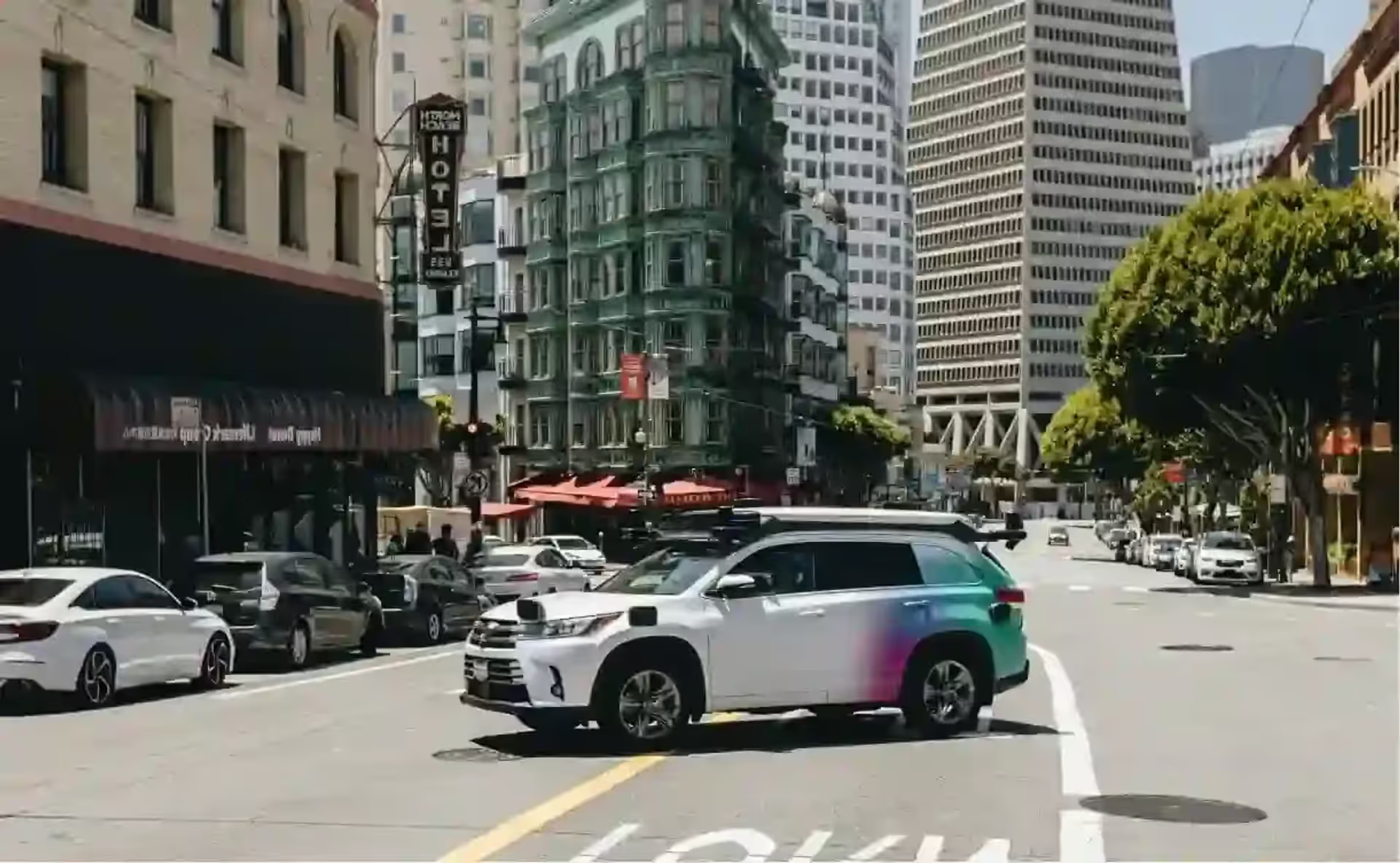
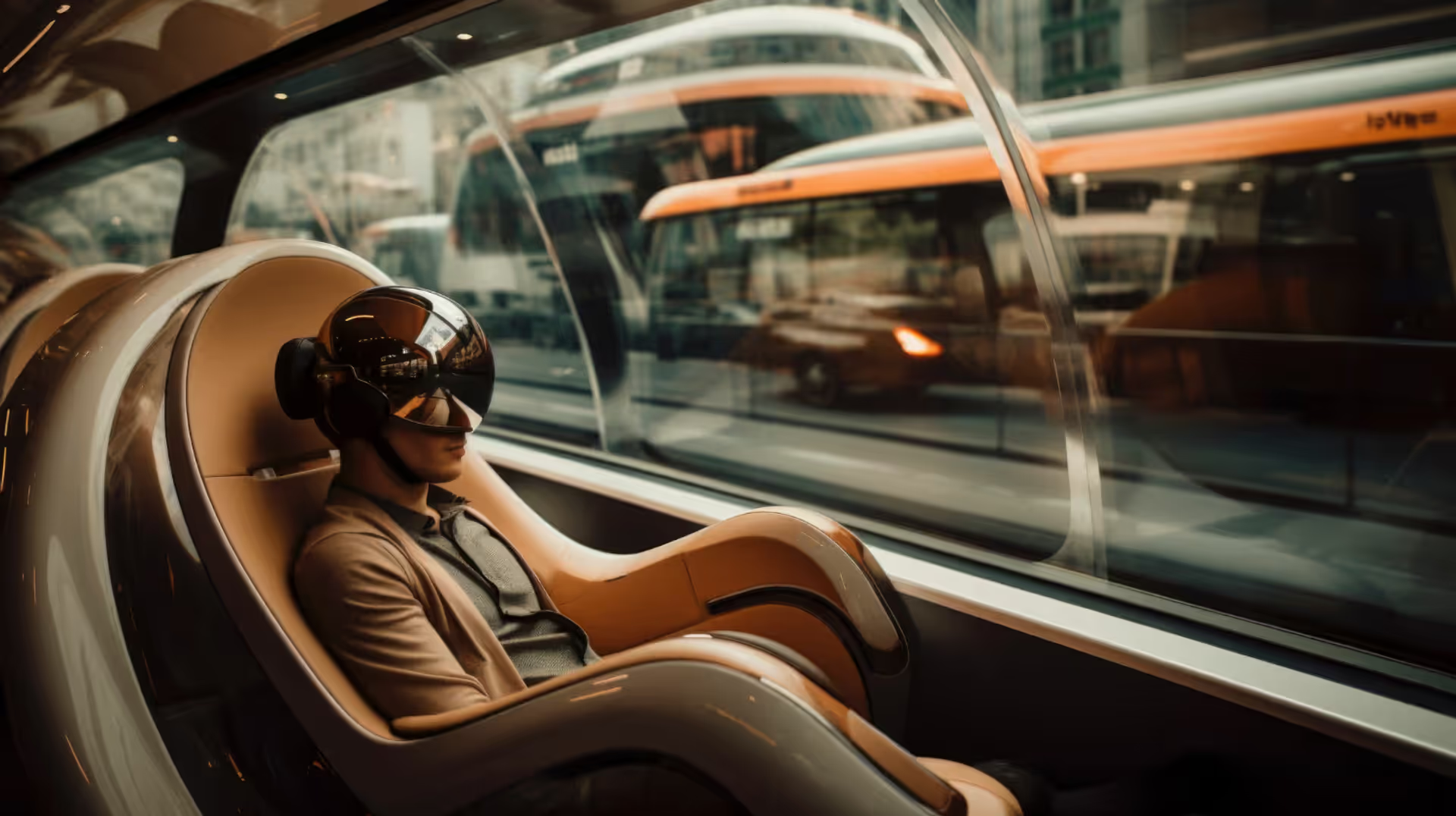
The future arrives without a driver.
Autonomous Driving in the Premium Segment: Robotaxi, L3/L4 Technologies

Content
Content
Introduction: When Luxury Meets Autonomy
The promise of autonomous driving has long captivated the imagination — the freedom to travel without the burden of driving, time reclaimed from the commute, mobility extended to those who cannot drive. Yet as autonomous technology matures from research project to commercial reality, a curious pattern has emerged. The most advanced autonomous systems are not appearing first in economy vehicles for the masses but in premium segments where the economics of high technology make sense and where customers value time and experience above all else.
This trajectory makes strategic sense when examined closely. Level 3 autonomous driving and Level 4 autonomous driving systems require sensor suites costing tens of thousands of dollars, computing platforms that rival supercomputers, and software development investments measured in billions. Deploying these systems in vehicles selling for $25,000 destroys the business case; deploying them in vehicles selling for $100,000 or more, or in premium autonomous ride services charging premium fares, creates pathways to profitability that justify the investment.
The convergence of autonomy and luxury is reshaping both industries in ways that neither anticipated. Traditional luxury automakers who built their brands around driving engagement must now contemplate vehicles where driving is optional or absent entirely. Technology companies that developed autonomous driving software for efficiency and safety find themselves designing experiences for passengers who expect champagne coolers and conference facilities in their vehicles. Robotaxi service operators who imagined replacing taxi drivers with computers are discovering that the highest margins exist not in commodity transportation but in luxury robotaxi services where passengers pay for privacy, comfort, and exclusivity.
The autonomous mobility services landscape in 2026 and 2027 reflects this premium orientation. Waymo operates its robotaxi fleet operations in carefully selected wealthy neighborhoods. Cruise, before its operational pause, targeted similar demographics. Mercedes-Benz has deployed SAE Level 3 autonomous vehicles in its flagship S-Class sedan. BMW and other premium manufacturers are preparing similar systems. The pattern is consistent: autonomy arrives first where customers can afford it and where margins can absorb technology costs.
"The premium segment is the natural beachhead for autonomous technology," observes an autonomous vehicle strategy analyst. "The customers have the means, the patience for early technology, and the willingness to pay for the experience rather than just the transportation."
This analysis examines the technological foundations of premium autonomous mobility, the business models emerging to commercialize it, and the regulatory and insurance frameworks that will determine how quickly autonomous luxury services can scale. Understanding these dynamics is essential for anyone seeking to comprehend where autonomous transportation is heading — and why it's heading there in a Mercedes rather than a Corolla.
Understanding Autonomous Driving Levels: From Assistance to Independence
The SAE International framework for classifying autonomous driving levels provides essential context for understanding what premium autonomous systems actually deliver. The distinctions between levels — particularly between Level 2, Level 3, and Level 4 — represent not incremental improvements but fundamental shifts in capability, responsibility, and user experience.
The Critical Threshold: Level 3 Autonomy
Level 3 autonomous driving represents the first stage at which the vehicle, rather than the driver, bears responsibility for the driving task under defined conditions. This distinction may seem semantic but carries profound implications for liability, insurance, and user experience. In a Level 2 system, however capable, the driver must maintain attention and remains legally responsible for vehicle operation. In a L3 autonomous driving system, the driver can genuinely disengage — reading, working, or relaxing — while the vehicle handles driving within its operational design domain.
The technical requirements for this responsibility transfer are substantial. A Level 3 system must not only perform the driving task adequately but must also recognize when conditions exceed its capabilities and provide sufficient warning for the driver to resume control. This "minimum risk condition" requirement means the system must monitor its own performance, assess environmental conditions continuously, and communicate with the driver about impending transitions. The engineering challenge is not merely driving well but knowing when you're not driving well and managing that situation safely.
Mercedes-Benz achieved a significant milestone by receiving regulatory approval for Level 3 operation in certain German highway conditions — the first such approval for a production vehicle from a traditional automaker. The system, branded Drive Pilot, operates at speeds up to 60 kilometers per hour in congested highway traffic during daylight hours on mapped routes with clear weather. These constraints illustrate that Level 3 approval represents not a general autonomous capability but a specific, validated capability within tightly defined parameters.
The premium segment's embrace of Level 3 reflects both technological necessity and market positioning. The sensor suites required — including lidar, radar, cameras, and ultrasonic sensors — add substantial cost that luxury price points can absorb. The liability implications, still being resolved, are easier to accept for manufacturers with strong balance sheets and established legal teams. And the value proposition — transforming congested commutes from stressful obligations to productive time — resonates particularly with affluent customers whose time carries high opportunity cost.
Level 4: Autonomy Without Backup
Level 4 autonomous driving removes the human driver from the safety equation entirely within its operational domain. A L4 autonomous driving platform does not require a human capable of taking control; indeed, it may not include controls for human intervention at all. This represents the capability level required for true driverless taxi service and autonomous chauffeur service operations where no human occupant bears driving responsibility.
The technical leap from Level 3 to Level 4 is less about raw capability than about reliability and edge case handling. A Level 3 system can rely on human backup when it encounters situations outside its training; a Level 4 system must handle or safely manage every situation it might encounter within its domain. This requirement drives the extensive validation programs that autonomous driving validation services provide — millions of miles of real-world testing supplemented by billions of simulated miles exploring edge cases that real-world driving rarely presents.
Current SAE Level 4 autonomous vehicles operate in robotaxi fleet operations in limited geographic areas — Phoenix suburbs for Waymo, portions of San Francisco before Cruise's pause, areas of China for various operators. These deployments demonstrate Level 4 capability but within constrained operational design domains that exclude challenging conditions. Expanding these domains — to new geographies, weather conditions, traffic patterns, and edge cases — represents the ongoing work that will determine how quickly Level 4 services can scale.
The premium mobility application for Level 4 differs from mass-market robotaxi visions. Where economy-focused operators imagine replacing taxi drivers with computers to reduce per-mile costs, luxury mobility services operators envision replacing chauffeurs with systems that provide superior privacy, availability, and consistency. A private autonomous car service that arrives precisely when summoned, offers complete privacy during transit, and delivers passengers refreshed rather than fatigued commands premium pricing that transforms the economics of autonomous deployment.
The Robotaxi Revolution: Current State and Premium Potential
The robotaxi service concept has evolved substantially from early visions of autonomous vehicles simply replacing taxi drivers. Current deployments reveal both the genuine progress achieved and the constraints that shape near-term scaling — constraints that increasingly point toward premium applications as the path to sustainable operations.
How Robotaxi Operations Actually Work
Understanding robotaxi fleet operations requires moving beyond conceptual descriptions to examine operational realities. Current deployments involve far more complexity and human involvement than popular narratives suggest.
Waymo's Phoenix operation, the most mature autonomous ride hailing service in the United States, provides instructive detail. Vehicles operate without human safety drivers in defined geographic areas, responding to ride requests through a consumer app. But behind this consumer-facing simplicity lies extensive infrastructure. Remote operations centers monitor vehicles continuously, with human operators available to provide guidance when vehicles encounter novel situations. Dedicated support teams can dispatch to handle mechanical issues, passenger problems, or edge cases that remote guidance cannot resolve. Maintenance facilities service vehicles on accelerated schedules, replacing components preemptively rather than waiting for failures. Mapping teams continuously update the HD maps that autonomous navigation requires, incorporating construction, road changes, and newly identified features.
This operational complexity explains why robotaxi fleet management represents a substantial portion of operating costs, potentially exceeding the driver costs that autonomous operation was supposed to eliminate. The path to profitability requires either reducing this operational overhead through improved autonomous capability or increasing revenue through premium positioning that justifies the costs.
The autonomous vehicle dispatch software that orchestrates these operations represents significant technological achievement in itself. Efficiently matching vehicles to ride requests while managing charging, maintenance, repositioning, and operational constraints requires optimization algorithms of considerable sophistication. The quality of this dispatch optimization directly affects fleet utilization and, consequently, unit economics. Premium services face additional dispatch complexity — ensuring that vehicles meeting higher specification standards (cleaner interiors, specific amenities, particular vehicle types) match to customers paying for those standards.
Premium Robotaxi: A Different Business Model
The luxury robotaxi concept differs fundamentally from economy-focused autonomous ride-hailing. Rather than competing with Uber and Lyft on price, premium autonomous services compete with black car services and private chauffeurs on experience — with the advantages that autonomy provides in privacy and consistency.
The privacy advantage deserves emphasis. A VIP autonomous transport service offers something no human-driven service can match: guaranteed privacy during transit. There is no driver to overhear business calls, observe personal interactions, or remember pickup and dropoff locations. For executives, celebrities, and high-net-worth individuals with genuine privacy concerns, this characteristic alone may justify substantial price premiums over chauffeur services where human drivers — however professional — represent inherent privacy compromises.
Consistency represents another premium advantage. Human drivers vary in skill, knowledge, professionalism, and daily performance. An executive autonomous transportation service delivers identical experience every time — same temperature, same route optimization, same amenities, same smooth driving dynamics. This consistency proves particularly valuable for customers with exacting standards and high expectations, who find variation in service quality more annoying than consistently adequate performance.
The robotaxi pricing models for premium services reflect these value propositions. Rather than per-mile rates competing with ride-sharing, premium services charge for time, exclusivity, and experience. An airport autonomous car servicemight charge a flat premium rate for airport transfers that includes guaranteed availability, luggage handling systems, flight monitoring, and post-flight amenities. An autonomous limousine service for corporate clients might charge monthly retainers for priority access and customized vehicle configurations. These pricing models escape the commoditization trap that threatens economy-focused robotaxi services.

Technology Stack: The Hardware and Software of Premium Autonomy
The technological foundation of premium autonomous vehicles combines sensing hardware, computing platforms, and software systems of remarkable sophistication. Understanding this stack illuminates why costs remain high, where competitive advantages emerge, and how the technology continues evolving.
Sensor Fusion: Seeing the World Completely
Modern autonomous vehicle sensor fusion combines multiple sensing modalities to create comprehensive environmental understanding that no single sensor type could provide. The lidar radar camera autonomous vehicles approach reflects hard-won lessons about the limitations and complementary strengths of each technology.
Lidar (Light Detection and Ranging) provides precise three-dimensional mapping of the vehicle's surroundings, measuring distances with centimeter accuracy across ranges exceeding 200 meters. The technology excels at detecting objects and understanding scene geometry regardless of lighting conditions. Modern lidar units have decreased dramatically in cost while improving in resolution and reliability, though they remain substantial cost contributors — high-specification units for premium applications may cost $5,000-$15,000 per vehicle, with multiple units required for comprehensive coverage.
Radar complements lidar with different strengths. Radar excels at velocity measurement, detecting moving objects and determining their speed and direction with precision lidar cannot match. Radar also performs well in adverse weather — rain, snow, fog — that can degrade lidar performance. The technology is mature and relatively inexpensive, benefiting from decades of development for aerospace and automotive applications.
Camera systems provide the rich visual information that humans use for driving — reading signs, understanding traffic signals, recognizing lane markings, and interpreting the countless visual cues that experienced drivers process unconsciously. Autonomous vehicle perception software has advanced remarkably in extracting this information from camera feeds, with neural network architectures achieving performance that approaches or exceeds human capability in many recognition tasks.
The integration of these sensor modalities through autonomous vehicle sensor fusion creates understanding greater than any component provides alone. When lidar detects an object at a certain distance, camera systems classify it, and radar measures its velocity, the fused understanding enables prediction of future positions and appropriate response. Redundancy across modalities provides reliability — if one sensor fails or is degraded, others can compensate. The sophistication of this fusion represents a key competitive differentiator among autonomous system developers.
High-Definition Maps and Localization
HD maps for autonomous vehicles provide environmental information beyond what sensors can perceive in real-time. These maps encode road geometry with centimeter precision, including lane boundaries, traffic control locations, speed limits, and the countless details that define how vehicles should behave at each location. The maps also include information about elements not visible to sensors — traffic light timing patterns, speed limits, lane use restrictions, and local driving conventions.
The creation and maintenance of HD maps represents substantial ongoing investment. Mapping vehicles must traverse routes repeatedly to build initial maps and verify continued accuracy. Changes — construction, road modifications, new signage — must be incorporated quickly to maintain map validity. The challenge scales with geographic coverage; maintaining current HD maps for an entire metropolitan area requires dedicated mapping operations running continuously.
Localization — determining precisely where the vehicle is within the HD map — enables the autonomous system to apply map-encoded information correctly. Matching sensor observations to map features allows position determination with accuracy far exceeding GPS, typically to within 10 centimeters. This precise localization enables the vehicle to know not just that it's on a particular road but exactly which lane, how far from lane boundaries, and what behavior the map prescribes for that specific location.
The proprietary nature of HD maps creates competitive dynamics worth noting. Companies that have invested in mapping particular areas possess valuable assets that new entrants must replicate. This creates both barriers to entry and strategic considerations for partnerships and market expansion. Autonomous mobility platform operators must either develop mapping capabilities internally or partner with mapping providers, with implications for competitive positioning and cost structure.
Simulation and Validation
Autonomous vehicle simulation software enables testing scenarios that real-world driving cannot efficiently provide. Rare events — near-collisions, unusual pedestrian behavior, equipment failures — occur too infrequently in actual driving to test through road miles alone. Simulation allows systematic exploration of these scenarios, identifying system weaknesses and validating improvements before deployment.
The sophistication of modern simulation environments has advanced remarkably. Physics engines model vehicle dynamics, sensor noise, and environmental interactions with fidelity sufficient for meaningful testing. Scenario generation systems create countless variations on challenging situations — different lighting, weather, actor behaviors, timing — that comprehensive testing requires. Verification that simulated performance transfers to real-world performance represents an ongoing validation challenge that autonomous driving validation services address through systematic comparison methodologies.
Autonomous vehicle testing services combine simulation with structured real-world testing to provide validation confidence. Closed-course testing evaluates specific maneuvers and scenarios under controlled conditions. Public road testing accumulates experience with the genuine variability of actual driving. The combination builds the evidence base that regulators require for operational approval and that operators need for deployment confidence.
Fleet Management and Operations: The Business Behind the Technology
The commercial viability of autonomous transportation service operations depends not only on the technology in vehicles but on the operational systems that manage fleets efficiently. Autonomous fleet management softwarerepresents a distinct technology domain with its own challenges and competitive dynamics.
Operational Complexity at Scale
Managing an autonomous mobility services fleet involves optimization challenges that multiply with scale. Each vehicle requires charging, maintenance, cleaning, and repositioning. Ride requests arrive stochastically, clustered by time and geography in patterns that change daily and seasonally. Matching supply to demand while minimizing empty miles and wait times requires algorithms of considerable sophistication.
The autonomous vehicle dispatch software that performs this matching must balance multiple objectives simultaneously. Minimizing customer wait times suggests positioning vehicles near anticipated demand; minimizing empty miles suggests keeping vehicles where they completed previous rides; ensuring adequate coverage across the service area requires some vehicles in locations that neither individual optimization would suggest. Adding considerations like vehicle charge levels, maintenance schedules, and service differentiation multiplies complexity further.
Robotaxi fleet management for premium services adds requirements beyond basic efficiency. Vehicles serving premium customers may require enhanced cleaning between trips, specific amenity provisioning, or particular vehicle types for specific customer requests. Ensuring that the right vehicle — not just an available vehicle — serves each request requires dispatch systems that track vehicle characteristics and match them to service requirements.
Cybersecurity: Protecting Connected Vehicles
Autonomous vehicle cybersecurity has become a critical concern as vehicles become networked systems connected to cloud infrastructure, mapping services, and fleet management platforms. The attack surface extends from vehicle sensors and computers through communication links to backend systems, creating multiple potential vulnerability points.
The consequences of cybersecurity failures in autonomous vehicles could be severe. Compromise of vehicle control systems could enable dangerous driving behavior. Access to fleet management systems could enable tracking of passenger movements or service disruption. Manipulation of HD map data could cause vehicles to behave unexpectedly. The potential for physical harm — not just data theft or service disruption — elevates cybersecurity requirements above those for conventional IT systems.
Addressing these risks requires security engineering throughout system design, not merely added security measures to completed systems. Vehicle architectures must isolate safety-critical functions from less critical systems, limiting the consequences of any individual compromise. Communication systems must authenticate and encrypt data exchanges, preventing interception and manipulation. Monitoring systems must detect anomalous behavior that might indicate compromise, enabling response before harm occurs.
Table 1: Autonomous Vehicle Technology Stack Components
| Component | Function | Key Technologies | Premium Considerations | Cost Range |
| Perception Sensors | Environmental sensing | Lidar, radar, cameras, ultrasonics | Higher resolution, redundancy | $15,000-$40,000 |
| Compute Platform | Data processing, decision-making | Custom AI accelerators, GPUs | Additional processing for enhanced features | $5,000-$15,000 |
| HD Maps | Precise environmental data | Centimeter-accuracy mapping | Coverage of premium service areas | Subscription + mapping ops |
| Localization | Position determination | Sensor-map matching, RTK GPS | Enhanced precision requirements | Integrated with compute |
| Fleet Management | Operational optimization | AI dispatch, route planning | Premium service matching logic | Software + operations |
| Connectivity | Vehicle-to-cloud communication | 5G, satellite backup | Redundant connectivity for reliability | $500-$2,000/year |
| Cybersecurity | System protection | Encryption, intrusion detection | Enhanced protection for VIP data | Integrated throughout |
Insurance and Liability: The Legal Framework for Autonomy
The question of who bears responsibility when autonomous vehicles cause harm remains incompletely resolved, with implications that particularly affect premium autonomous services where incident costs and customer expectations are both elevated. Autonomous vehicle insurance represents an evolving product category adapting to unprecedented risk profiles.
The Liability Shift in Autonomous Vehicles
Traditional automotive liability places responsibility primarily on human drivers, with manufacturer liability arising mainly from defects rather than operational decisions. Autonomous vehicles disrupt this framework fundamentally. When the vehicle — not the human — makes driving decisions, the basis for driver liability weakens while the basis for manufacturer or operator liability strengthens.
Autonomous vehicle liability in Level 3 systems presents particular complexity. During autonomous operation, the vehicle bears responsibility; during human operation, the driver bears responsibility; during transitions between modes, responsibility allocation may be unclear. The precise moment when responsibility transfers — when the system requests human takeover, when the human acknowledges, when the human actually has control — creates ambiguity that litigation will eventually resolve but that currently creates uncertainty.
Level 4 systems simplify some aspects by removing driver responsibility entirely within the operational domain. The robotaxi insurance market for Level 4 operators must price coverage for full operational liability without driver contribution. This creates clearer responsibility allocation but also concentrates liability with operators who may lack the financial depth to absorb major claims. Catastrophic incidents — multiple-fatality crashes, for example — could generate liability exceeding operator resources, raising questions about claimant recovery and systemic stability.
"The insurance industry is building the airplane while flying it," notes an autonomous vehicle insurance specialist. "We're developing products for risks we can't fully quantify because we lack historical data. Premium services at least offer higher revenues to offset this uncertainty."
Insurance Products and Pricing
The self driving car insurance market has developed product structures adapted to autonomous vehicle characteristics, though these remain early-stage and subject to revision as loss experience accumulates.
AV insurance solutions for fleet operators typically combine multiple coverage components. Commercial auto liability covers third-party injury and property damage claims. Product liability coverage addresses claims alleging vehicle defects caused harm. Cyber liability coverage addresses claims arising from cybersecurity incidents. Errors and omissions coverage addresses claims that inadequate service caused customer harm. The combination creates comprehensive protection but at premiums reflecting uncertainty about actual loss rates.
Autonomous fleet insurance pricing reflects this uncertainty through premiums that may exceed those for human-driven fleets despite autonomy's safety promise. Insurers cannot yet validate safety claims with actuarial data because the claims history is too limited. Until sufficient operational data accumulates to support loss rate estimation, insurers must price conservatively, adding risk margins that may prove unnecessary but that cannot be eliminated absent supporting data.
Premium autonomous services face insurance considerations beyond basic liability coverage. Customer expectations include not just safe transport but also protection for belongings, privacy, and experience quality. A VIP autonomous transport service that damages customer luggage, exposes private conversation data, or delivers a terrible experience faces reputational consequences beyond direct liability. Insurance products addressing these service quality aspects are evolving alongside basic liability coverage.

Regional Perspectives: How Markets Are Approaching Autonomous Luxury
The development and deployment of premium autonomous services varies significantly across major markets, reflecting different regulatory approaches, technology ecosystems, and consumer expectations. These variations shape where advanced autonomous services appear first and how they spread globally.
United States: Technology Leadership with Regulatory Fragmentation
The United States hosts the most advanced autonomous ride hailing service operations globally, with Waymo's Phoenix deployment representing the most mature commercial driverless taxi service anywhere. This leadership reflects the concentration of autonomous technology development in American companies — Waymo, Cruise, Aurora, and others — and regulatory environments in certain states that have permitted extensive testing and initial deployment.
The regulatory fragmentation that characterizes American governance creates both opportunity and constraint. States like Arizona and California have enabled deployments that more restrictive environments would prevent. But this same fragmentation means that scaling nationally requires navigating fifty different regulatory frameworks, each with distinct requirements and approval processes. The autonomous mobility platform operator that succeeds in Phoenix cannot simply expand to New York or Florida without substantial additional regulatory engagement.
Premium autonomous services in the United States benefit from a customer base accustomed to premium transportation options and willing to pay for enhanced experiences. The executive autonomous transportation market in cities like San Francisco and Los Angeles includes potential customers with high willingness to pay and strong privacy preferences that autonomous services can address. The challenge lies in scaling beyond the limited geographic areas where Level 4 operation is currently permitted.
China: Scale and Integration
China's approach to autonomous vehicles combines substantial government support with integration into broader mobility ecosystems that create distinctive deployment patterns. Companies like Baidu (Apollo), Pony.ai, and AutoX operate robotaxi fleet operations in multiple Chinese cities, with deployment scales and geographic coverage that exceed American operations.
The integration with China's advanced mobile payment and super-app ecosystems enables service access and monetization approaches that American and European operators cannot easily replicate. A robotaxi service in China can integrate with Baidu Maps, Alipay, and other platforms that hundreds of millions of consumers already use daily. This integration reduces customer acquisition costs and enables cross-service monetization that standalone operators cannot achieve.
Chinese premium autonomous services benefit from a rapidly growing wealthy population with strong technology adoption tendencies. The luxury robotaxi market in cities like Shanghai and Shenzhen includes consumers who have embraced domestic luxury brands and premium services across categories. The willingness to adopt premium autonomous services from domestic technology companies may exceed that in Western markets where premium connotations still attach primarily to established luxury brands.
Europe: Regulatory Precision and Premium Heritage
European approaches to autonomous vehicles reflect the region's general regulatory philosophy — detailed requirements established in advance rather than permissive frameworks that allow experimentation. The regulatory precision provides clarity but also creates approval processes that proceed more slowly than the American approach.
The premium autonomous market in Europe benefits from the region's heritage in luxury automotive manufacturing. Mercedes-Benz, BMW, and other premium manufacturers have established customer relationships and brand equity that autonomous technology can extend rather than disrupt. A Level 3 autonomous driving system from Mercedes feels like a natural evolution of luxury motoring rather than a disruption imposed by technology companies. This brand continuity may prove valuable in building premium autonomous services that inherit rather than must establish luxury credentials.
European regulatory frameworks increasingly accommodate autonomous vehicles, with the UNECE establishing international standards that member countries can adopt. Germany's approval of Mercedes Drive Pilot for Level 3 operation demonstrated that European regulatory processes can accommodate advanced autonomy, though the specific conditions and requirements remain stringent.
Business Models and Economics: Paths to Profitability
The economic sustainability of autonomous transportation service operations depends on business models that generate sufficient revenue to cover substantial technology and operational costs. The evolution of these models increasingly points toward premium positioning as the path to profitability.
The Unit Economics Challenge
The fundamental challenge for robotaxi business model sustainability lies in unit economics — the revenue and cost per ride or per mile that determines profitability at scale. Early robotaxi business models assumed that eliminating driver costs would create dramatic cost advantages over ride-sharing services, enabling lower prices and higher volumes that would achieve profitability through scale.
Experience has complicated this assumption. While autonomous vehicles eliminate driver wages, they introduce costs that human-driven services do not bear. Remote operations support, enhanced maintenance and cleaning, technology amortization, HD map maintenance, and operational overhead may collectively approach or exceed the driver costs eliminated. If autonomous rides cost roughly the same to operate as human-driven rides, the value proposition must rely on factors other than cost — factors like consistency, availability, privacy, and experience that premium positioning emphasizes.
The robotaxi pricing implications are significant. Economy-focused robotaxi services competing on price with Uber and Lyft face thin margins even if cost parity is achieved, because ride-sharing already operates on thin margins after years of competition. Premium services charging substantial premiums over ride-sharing can achieve margins that cover technology costs even if those costs never reach the levels originally hoped.
Table 2: Premium Autonomous Mobility Business Models
| Service Type | Target Customer | Value Proposition | Pricing Model | Key Success Factors |
| Luxury Robotaxi | Affluent urban travelers | Privacy, consistency, comfort | Premium per-ride pricing | Fleet quality, service area coverage |
| Executive Transport | Business travelers, executives | Productivity, reliability, privacy | Corporate accounts, monthly retainers | Integration with business systems |
| Airport Service | Frequent flyers, business travelers | Reliability, luggage handling | Flat rate airport transfers | Airport access agreements, flight integration |
| VIP Events | High-net-worth individuals | Exclusivity, discretion | Event-based premium pricing | Vehicle presentation, staff training |
| Private Fleet | Ultra-high-net-worth individuals | Complete control, customization | Vehicle purchase + service contracts | Customization capability, concierge service |
Premium Service Revenue Models
The premium autonomous ride service business model differs fundamentally from economy robotaxi approaches. Rather than maximizing utilization through low prices and high volume, premium services optimize for experience quality and customer willingness to pay. This approach accepts lower utilization rates — vehicles may sit unused more often — in exchange for higher revenue per trip and stronger customer loyalty.
An autonomous chauffeur service targeting corporate clients might charge monthly retainers that guarantee vehicle availability during business hours, with additional charges for after-hours use. The retainer model provides revenue predictability for operators while providing availability assurance for customers. A Fortune 500 executive who knows an autonomous vehicle will be available whenever needed values that certainty beyond the cost of individual rides.
The airport autonomous car service represents a particularly attractive premium segment. Airport transfers involve predictable demand patterns, customers with low price sensitivity and high reliability requirements, and natural service quality differentiation opportunities. The vehicle that monitors flight status, adjusts pickup timing for delays or early arrivals, and provides post-flight refreshments creates an experience that commands premiums over standard ride-hailing. Airport access agreements and pickup zone placement become competitive advantages that scale with relationship development over time.
The Future of Luxury Autonomous Mobility
The trajectory of premium autonomous services points toward expansion and refinement as technology improves and business models mature. Understanding this trajectory helps stakeholders — from manufacturers to service operators to customers — position for the autonomous mobility future.
Technology Evolution
The technology stack underlying premium autonomous services will continue advancing, enabling new capabilities and experiences. Sensor costs will decline while performance improves, eventually allowing technology deployment in lower-price-point vehicles. But the premium segment will absorb these advances into enhanced capability rather than reduced prices — more sensors providing better coverage, more computing enabling more sophisticated scene understanding, more data improving prediction accuracy.
Solid-state lidar represents one anticipated advancement that could significantly improve premium autonomous vehicles. Current mechanical lidar units are relatively bulky and create distinctive visual signatures; solid-state alternatives promise smaller form factors that integrate more seamlessly into vehicle design. For premium applications where aesthetic integration matters, this evolution enables vehicles that look like luxury automobiles rather than sensor platforms.
Vehicle-to-everything (V2X) communication will enhance autonomous vehicle capability by providing information beyond what onboard sensors can perceive. Communication with traffic infrastructure reveals signal timing and traffic management intentions. Communication with other vehicles enables coordinated maneuvering and early warning of upstream conditions. While V2X deployment remains limited, the premium segment may see earlier integration as infrastructure expands in key service areas.
Service Expansion
The geographic expansion of premium autonomous services will follow patterns distinct from economy-focused robotaxi deployment. Where economy services prioritize large markets with dense demand, premium services may target wealthy enclaves, business districts, and specific routes connecting premium destinations regardless of surrounding deployment.
"Premium autonomous services don't need to cover entire cities to be valuable," explains a mobility services executive. "Connecting the airport to the financial district to the luxury hotel corridor creates a premium service footprint that high-value customers want, even without covering residential neighborhoods or suburban areas."
The integration of premium autonomous transportation with other luxury services creates ecosystem opportunities. Hotels, airlines, and venue operators may partner with autonomous service providers to offer integrated experiences — the vehicle that meets you at the airport already knowing your hotel, your dinner reservation, and your morning flight. These integrations create service differentiation and customer lock-in that standalone transportation services cannot achieve.
Toward Truly Driverless Luxury
The ultimate vision for luxury autonomous mobility eliminates the driver entirely, not as a cost reduction measure but as an experience enhancement. The vehicle designed from inception without a driver — without a driving position, without controls, without the assumption that anyone inside will ever need to drive — can be configured entirely around passenger experience.
This vision, still years from widespread realization, enables interiors impossible in driver-dependent vehicles. Seats can face any direction, can convert to beds, can configure as conference rooms or private offices. The space currently occupied by driver's seat, steering column, and instrument cluster becomes passenger space. The vehicle becomes not transportation but mobile environment — a private space that happens to move.
The premium segment will see this transformation first, in purpose-built vehicles for luxury mobility services that prioritize experience over the flexibility of human-operable alternatives. The autonomous limousine service of the future will not merely replace the human driver with computers; it will reimagine the vehicle around what passengers actually want from transit time — privacy, comfort, productivity, and occasionally, pure relaxation.
Conclusion: Where Luxury and Autonomy Converge
The convergence of autonomous driving technology and premium mobility services represents not a compromise but a natural alignment. The technology costs that make autonomous vehicles challenging for economy applications become manageable in premium segments where customers pay for capability and experience rather than minimizing transportation cost. The experience differentiation that autonomy enables — perfect privacy, flawless consistency, productive transit time — addresses precisely what premium customers value most.
The robotaxi service vision that captured public imagination a decade ago — autonomous vehicles as cheap, ubiquitous transportation replacing human drivers to reduce costs — has proven more complex than anticipated. The luxury robotaxi alternative, which replaces human drivers to improve privacy and consistency for customers willing to pay premium prices, may prove more achievable in the near term. The path to autonomous mobility at scale may run through premium applications that demonstrate value and refine operations before broader deployment becomes economically viable.
The technology underlying this transformation — Level 3 autonomous driving systems for premium passenger vehicles, Level 4 autonomous driving platforms for autonomous mobility services, the sensors and software and infrastructure that enable machine-driven transportation — continues advancing rapidly. Each year brings better perception, more reliable decision-making, expanded operational domains, and improved safety records. The premium segment provides the revenue and margin to fund this advancement while building the operational experience that broader deployment will eventually require.
For manufacturers, the strategic implication is clear: autonomy represents not a threat to premium positioning but an enhancement of it. The luxury brand that masters autonomous technology creates competitive advantages that extend rather than undermine traditional brand equity. For operators, premium services offer economics that economy-focused models struggle to achieve. For customers, premium autonomous services offer something genuinely new — not just transportation but privacy, not just mobility but productivity, not just travel but experience.
The future of mobility is autonomous. The path to that future runs through the premium segment, where the economics work, the customers wait, and the experience possibilities justify the technology investment required to realize them. When autonomy arrives at scale, it will arrive in luxury first — and the experience it provides there will define what the world eventually expects from self-driving vehicles everywhere.
Related Stories

Read more

Read more