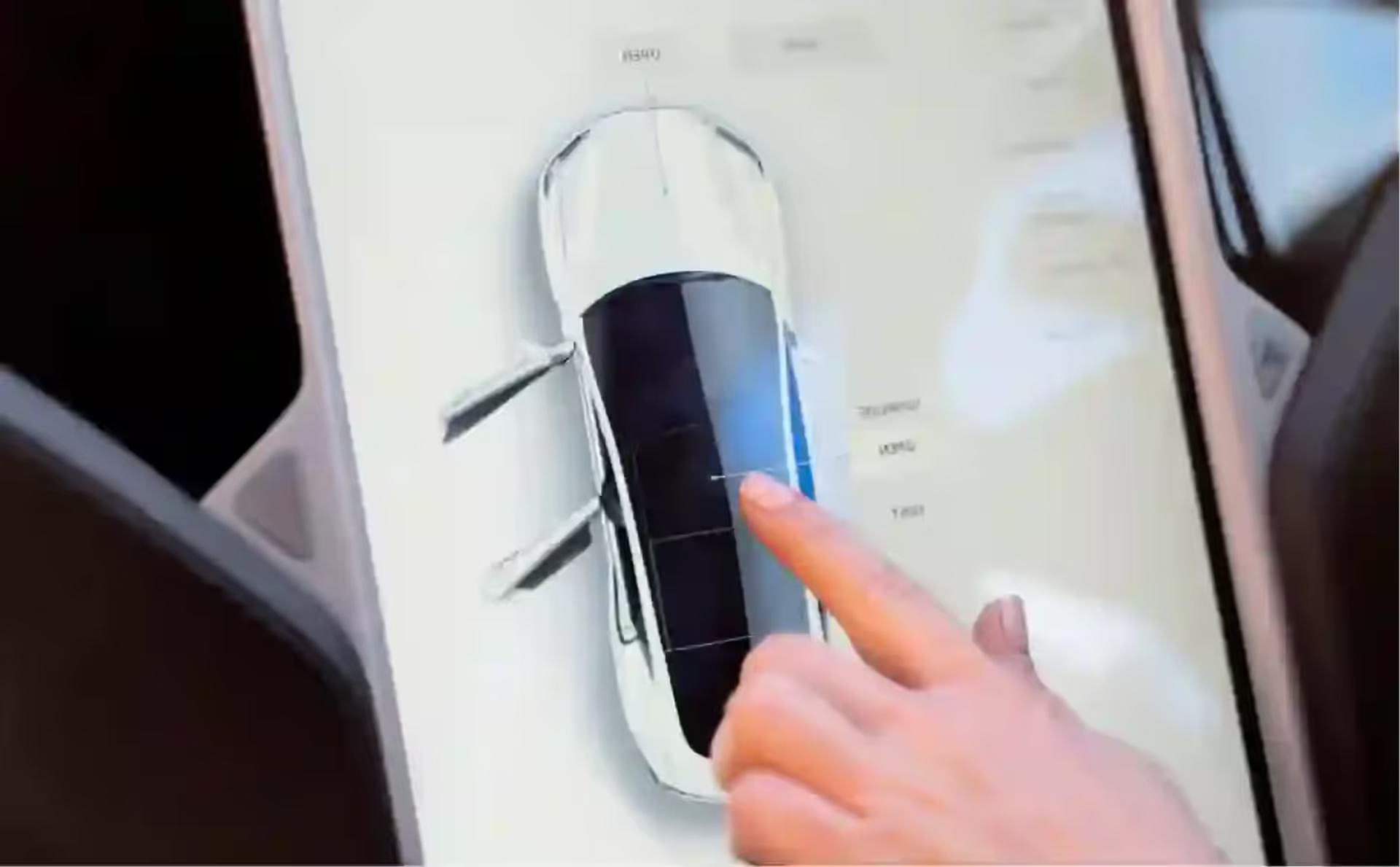
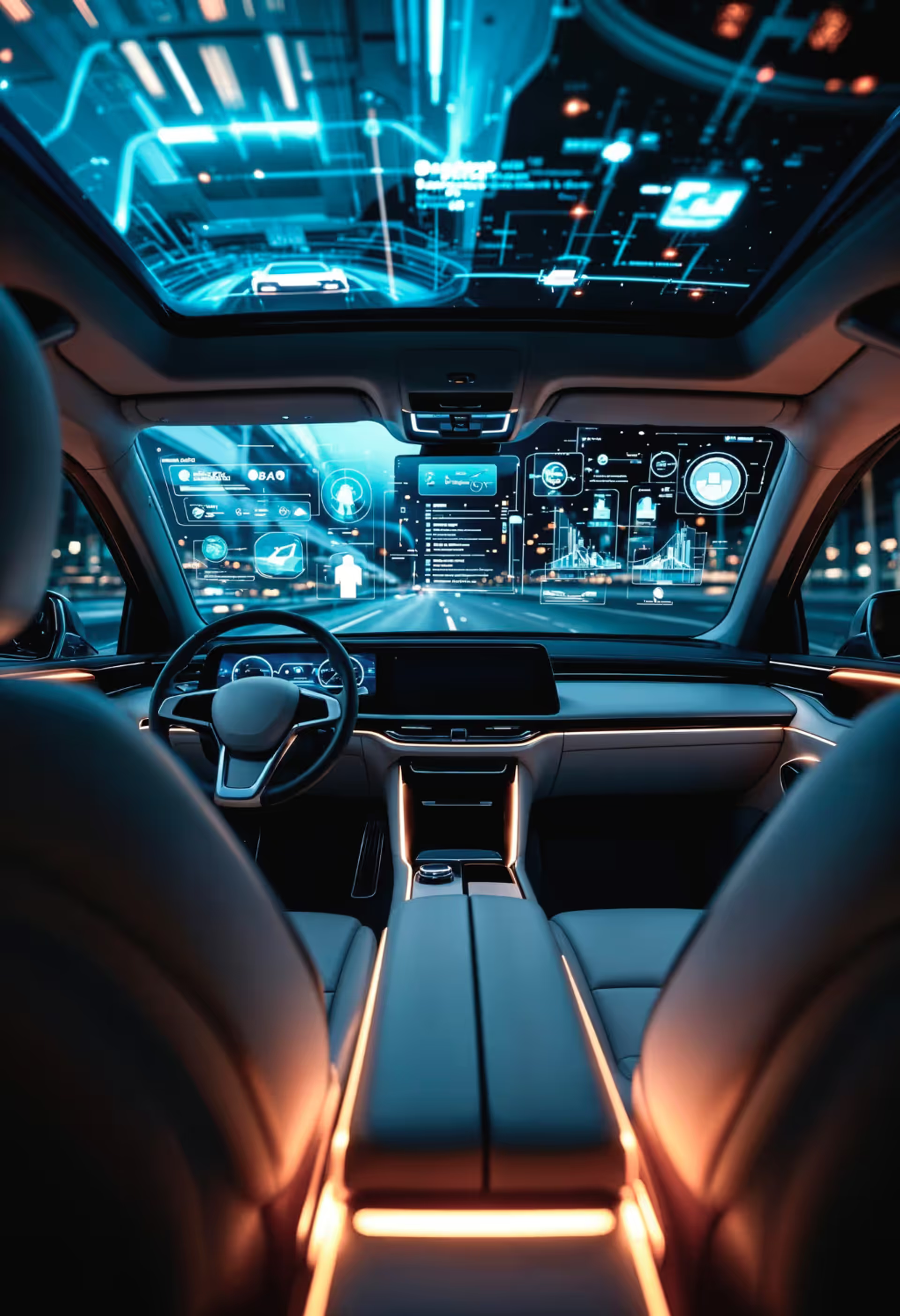
The convergence of electrification, autonomy, and connectivity is redefining what vehicles can do.
Automotive Technology: EVs, Software & Connectivity

Content
Content
Introduction: The Future of Automotive Technology
The automotive industry is experiencing the most substantial transformation since Henry Ford industrialized manufacturing over a century ago. The automotive industry trends 2026 reveal a sector being reshaped by forces far more profound than simple evolutionary improvements. Unlike previous shifts that focused on mechanical enhancements or manufacturing efficiency, today's revolution is driven by a convergence of technologies that are fundamentally redefining what a vehicle is, how it operates, and how humans interact with it. In 2026, cars are no longer merely mechanical machines — they are becoming software-defined vehicles on wheels, mobile computers capable of learning, connecting, and in some cases, driving themselves.
This transformation is triggered not only by extensive technology development but also by profound social and environmental demands. Climate change has accelerated the push toward electric vehicles 2026 and beyond. Urbanization has created demand for smarter mobility solutions. Consumer expectations, shaped by smartphones and digital services, now demand that vehicles offer the same level of connectivity, personalization, and continuous improvement through over-the-air updates cars receive regularly. The result is an industry in flux, where traditional automakers compete with tech giants and startups, where the value of a vehicle is increasingly defined by its automotive software platforms rather than its engine, and where the boundaries between automotive, technology, and energy sectors are blurring beyond recognition.
The most important automotive technology trends 2026 include the continued rise of electric car technology despite market challenges, breakthrough advances in autonomous driving systems, the emergence of connected car technology, expanding vehicle connectivity through 5G networks and vehicle-to-everything V2X communication, and the integration of artificial intelligence into every aspect of automotive design, manufacturing, and user experience. These car technology trends are interconnected — progress in one area enables advances in others, creating a feedback loop of automotive innovation 2026 that is accelerating the pace of change throughout the industry.
Electric Vehicles 2026: EV Technology Trends and Market Evolution
The State of Electric Car Technology in 2026
China leads global electric vehicle production with over 70% of production and 67% of global sales in 2024. The electric vehicles 2026 revolution continues to reshape the automotive landscape, though this year marks a period of recalibration rather than unbridled growth. After years of exponential expansion driven by government incentives, environmental regulations, and consumer enthusiasm, the EV technology trendsshow a market encountering the complex realities of mainstream adoption: infrastructure gaps in rural and suburban areas, persistent consumer range anxiety despite improving electric vehicle range improvement, higher purchase prices compared to internal combustion alternatives, and the rollback of some government incentives in major markets including the United States.
Despite these headwinds, the fundamental trajectory toward electrification remains unchanged. Environmental regulations continue tightening globally, with the European Union and China maintaining aggressive emissions targets that effectively mandate electrification for automakers selling in those markets. Battery costs, while no longer declining as rapidly as in previous years, continue their downward trend — the average cost per kilowatt-hour has fallen from over $1,000 in 2010 to under $140 in 2026, with further declines expected as manufacturing scale increases and battery technology for electric vehicles improves. EV charging technologyinfrastructure expands steadily, with major investments from both public and private sectors; the number of public charging points globally has more than tripled since 2020, with fast charging EV stations becoming increasingly common along major highways.
Most significantly, automakers have committed hundreds of billions of dollars to electric car technology development — investments that cannot be easily reversed and that will continue driving EV advancement regardless of short-term market fluctuations. General Motors alone has committed over $35 billion to electric and autonomous vehicles; Volkswagen Group's electrification budget exceeds €180 billion through 2030. These commitments represent factory construction, supplier contracts, and engineering programs that are already underway. The question is no longer whether the future of automotive technology is electric, but how quickly that future will arrive and what shape it will take during the transition period.
Battery Technology for Electric Vehicles: The Solid-State Horizon
Battery technology for electric vehiclesremains the critical enabler and constraint of EV development, simultaneously determining range, cost, charging speed, safety, and longevity. Current lithium-ion batteries, while dramatically improved from a decade ago, still face fundamental limitations: energy density constraints that limit electric vehicle range improvement to 250-350 miles for most vehicles, degradation over time that affects resale values and raises concerns about battery replacement costs, safety concerns requiring complex thermal management systems that add weight and cost, and reliance on supply chains concentrated in a few countries that creates geopolitical vulnerabilities.
These limitations have driven intensive research into next-generation battery technology for electric vehicles, with solid-state batteriesrepresenting the most promising near-term advancement. Solid-state batteries replace the liquid electrolyte in conventional lithium-ion cells with a solid material — typically a ceramic, glass, or polymer — offering several theoretical advantages: higher energy density enabling longer range in smaller, lighter packages; improved safety due to elimination of flammable liquid electrolytes that can cause fires in crash situations; fast charging EV capabilities that could reduce charging times to minutes rather than hours; and longer lifespan with less degradation over time and charge cycles.
Toyota, which has been notably cautious about battery EVs while competitors rushed to market, has announced plans to introduce solid-state batteries in production vehicles by 2027-2028, potentially leapfrogging current EV leaders with superior battery technology. Several Chinese manufacturers, including CATL and BYD, claim they will achieve commercial solid-state production even sooner. Samsung SDI and LG Energy Solution are also racing toward production. The transition from laboratory to mass production remains challenging — solid-state batteries have been "five years away" for over a decade — but the first production vehicles with this revolutionary battery technology for electric vehicles are now genuinely on the near-term horizon rather than in the realm of distant possibility.
💡 Key Insight — The Hybrid Renaissance: Despite initial EV enthusiasm, 2026 is witnessing a hybrid vehicle renaissance. Hybrids combine electric efficiency with internal combustion reliability, don't require charging infrastructure, reduce carbon emissions, and cost less than pure EVs. Many automakers are pivoting toward hybrid models as a practical bridge technology while EV infrastructure matures.
China's Dominance and Global EV Platform Technology Competition
China's position as the global leader in electric vehicles 2026 has consolidated further, with Chinese manufacturers now competing aggressively in European and emerging markets. Companies like BYD, NIO, and Xpeng have developed vehicles that match or exceed Western competitors in electric car technology while maintaining significant cost advantages derived from vertical integration, massive domestic scale, advanced EV platform technology, and government support. This competitive pressure has forced traditional automakers to accelerate their own EV technology trends development while simultaneously defending their market positions with improved internal combustion and hybrid offerings.
The geopolitical dimensions of electric vehicles 2026 competition have intensified, with tariffs, local content requirements, and battery technology for electric vehicles supply chain concerns creating complex strategic calculations for manufacturers. The Inflation Reduction Act in the United States, European battery regulations, and various national industrial policies are reshaping where vehicles and components are manufactured, often prioritizing domestic production over global efficiency. For consumers, this means that vehicle availability, pricing, and features increasingly depend on where they live and which manufacturers have adapted their EV platform technology to local regulatory requirements.
Autonomous Driving: The Long Road to Level 3 and Beyond
Understanding the Levels of Autonomy
The Society of Automotive Engineers (SAE)defines six levels of driving automation, from Level 0 (no automation) to Level 5 (full automation in all conditions). As of 2026, no system has achieved Level 5 autonomy, and even Level 3 — where the vehicle can drive itself under specific conditions while the human serves as a backup rather than a constant monitor — remains limited to a handful of models operating in restricted circumstances. Understanding these levels is essential for separating marketing claims from technological reality, particularly given the confusion created by product names like Tesla's "Full Self-Driving" that suggest capabilities beyond what the systems actually provide.
Level 2 systems, which include Tesla's Autopilot, GM's Super Cruise, and Ford's BlueCruise, can handle steering, acceleration, and braking simultaneously, but require the driver to remain attentive and ready to take control at any moment. The driver's hands may leave the wheel briefly on some systems, but their eyes must remain on the road and they bear full responsibility for the vehicle's operation. These systems have become increasingly sophisticated, with hands-free operation on mapped highways becoming common in premium vehicles, automatic lane changes initiated by turn signal, and improved performance in construction zones and other challenging environments. The industry has introduced the concept of "Level 2+" to describe enhanced systems that approach but don't quite reach Level 3 capabilities — offering features like automatic lane changes without driver initiation and improved performance in complex situations while still requiring driver supervision.
The distinction between Level 2+ and Level 3 might seem subtle to consumers — in both cases, the car appears to be driving itself — but it represents a fundamental legal and technological boundary. At Level 2+, if an accident occurs while the system is engaged, the driver is responsible; they were supposed to be supervising. At Level 3, responsibility shifts to the vehicle manufacturer under defined circumstances. This shift requires not just better technology but comprehensive changes to legal frameworks, insurance models, and regulatory oversight that take years to develop and implement.
The Level 3 Breakthrough: Eyes Off the Road
Level 3 represents a fundamental shift in the relationship between human and machine: for the first time, the driver can legally and safely disengage from monitoring the road, trusting the vehicle to handle all driving tasks within its operational design domain (ODD). When the system reaches its limits — approaching an intersection, encountering road construction, or exceeding speed limits for autonomous operation — it must provide sufficient warning for the driver to resume control safely. This "handoff" moment has been a major focus of research and development, as studies show that distracted humans take significant time to reorient and assume control of a vehicle they haven't been actively monitoring.
Mercedes-Benz Drive Pilot, available on the 2026 S-Class and EQS in select U.S. states (California and Nevada) and Germany, represents the most advanced commercially available Level 3 system, though it operates only in specific conditions — heavy traffic on mapped highways at speeds below 40 mph (60 km/h in Europe). Within this envelope, drivers can legally take their eyes off the road, watch video, or engage with their phones. The vehicle uses a combination of LiDAR, radar, cameras, and precise positioning to monitor its surroundings and makes driving decisions without human input. BMW has received similar certification in Germany for its Personal Pilot L3 system, with U.S. approval expected to follow.
The significance of Level 3 extends beyond technology to legal and liability frameworks that have governed automobile accidents since vehicles were invented. When Mercedes-Benz received Level 3 certification, the company accepted liability for accidents occurring while Drive Pilot was engaged and operating normally — a revolutionary shift from the driver-responsibility model. This liability acceptance required confidence not only in the technology itself but in the legal and insurance frameworks surrounding it. Mercedes reportedly worked with insurance companies and regulators for years before launch, establishing protocols for determining when the system was engaged, how to investigate accidents involving Level 3 vehicles, and how to allocate responsibility between driver and manufacturer. This complexity explains why Level 3 adoption has been slower than technologists predicted: the technical challenges are matched by regulatory, legal, and business model challenges that must all be resolved simultaneously.
ADAS: The Technology That's Actually Saving Lives
While fully autonomous vehicles remain years away from widespread deployment, Advanced Driver Assistance Systems (ADAS) are delivering safety benefits today. Features like automatic emergency braking, lane departure warning, blind spot monitoring, and adaptive cruise control have become standard equipment on most new vehicles. Research consistently shows that these systems reduce accidents: the Insurance Institute for Highway Safety estimates that forward collision warning with automatic braking reduces rear-end crashes by approximately 50%.
ADAS features transforming vehicle safety in 2026 include:
- Automatic Emergency Braking (AEB):Uses cameras and radar to detect imminent collisions and applies brakes automatically if the driver fails to respond. Now mandated on all new vehicles in Europe and increasingly standard in other markets. Studies show AEB reduces rear-end crashes by 50% and injuries by 56%.
- Lane Keeping Assist (LKA): Provides steering input to keep the vehicle centered in its lane, working continuously rather than just warning when lane departure is detected. Advanced systems can handle curves and work in conjunction with adaptive cruise control for semi-autonomous highway driving.
- Blind Spot Monitoring (BSM): Uses radar sensors to detect vehicles in adjacent lanes that may not be visible in mirrors, providing visual and audible warnings before lane changes. Some systems add steering intervention to prevent dangerous lane changes.
- Adaptive Cruise Control (ACC): Maintains set speed while automatically adjusting to traffic ahead, including complete stop-and-go capability in traffic jams. Premium systems incorporate predictive features using GPS data to anticipate curves, hills, and speed limit changes.
- Driver Monitoring Systems (DMS):Cameras track eye movement, head position, and facial expressions to detect distraction or drowsiness. Essential for Level 2+ systems where hands-free driving is permitted; the system ensures the driver remains attentive and ready to take control.
- 360-Degree Camera Systems: Multiple cameras create a bird's-eye view of the vehicle and surroundings, aiding parking and low-speed maneuvering. Advanced systems detect pedestrians, cyclists, and obstacles with automatic braking for parking situations.
The proliferation of ADAS is creating a data feedback loop that benefits autonomous vehicle development. Every vehicle equipped with cameras, radar, and sensors generates data about road conditions, driver behavior, and edge cases that challenge automated systems. This data, when aggregated across millions of vehicles, provides the training material that machine learning systems need to improve. Companies like Tesla, which collect data from their entire fleet, and Mobileye, which supplies ADAS systems to multiple manufacturers, are building massive datasets that inform the development of more capable autonomous systems. The cars of today are training the autonomous vehicles of tomorrow.
| Autonomy Level | Driver Role | System Capability | 2026 Availability |
| Level 0 | Full control required | Warnings only (blind spot, collision) | All vehicles |
| Level 1 | Hands on, eyes on | Adaptive cruise OR lane centering | Most new vehicles |
| Level 2 | Hands on, eyes on | Cruise AND lane centering together | Widely available |
| Level 2+ | Hands free, eyes on | Highway driving, auto lane change | Premium vehicles |
| Level 3 | Available as backup | Eyes off in specific conditions | Mercedes, BMW (limited) |
| Level 4 | Not required in ODD | Full autonomy in defined areas | Robotaxis only |
| Level 5 | Not required anywhere | Full autonomy everywhere | Not available |
Software-Defined Vehicles: Automotive Software Platforms Revolution
What Makes a Vehicle "Software-Defined"
Software-defined vehicles represent a fundamental architectural shift in how automobiles are designed, built, and updated. Traditional vehicles have dozens of separate electronic control units (ECUs), each running its own software to manage specific functions — engine, transmission, brakes, infotainment, etc. These systems are largely fixed at the time of manufacture, with limited ability to add features or fix problems after the vehicle leaves the factory. Software-defined vehicles consolidate these functions into fewer, more powerful computing platforms running sophisticated automotive software platforms that can be updated continuously throughout the vehicle's life.
The implications of this shift are profound. A software-defined vehicle can improve after purchase: Tesla has famously added features like "Dog Mode," improved acceleration, and extended range through over-the-air updates cars receive while parked in customer driveways. BMW's Neue Klasse platform, launching in 2025-2026, represents a traditional automaker's comprehensive embrace of the SDV concept, with a unified computing architecture designed from the ground up to support continuous software evolution. Mercedes-Benz MB.OS, Volkswagen's unified software platform, and similar initiatives demonstrate that the entire industry recognizes software-defined vehicles as the future of automotive technology.
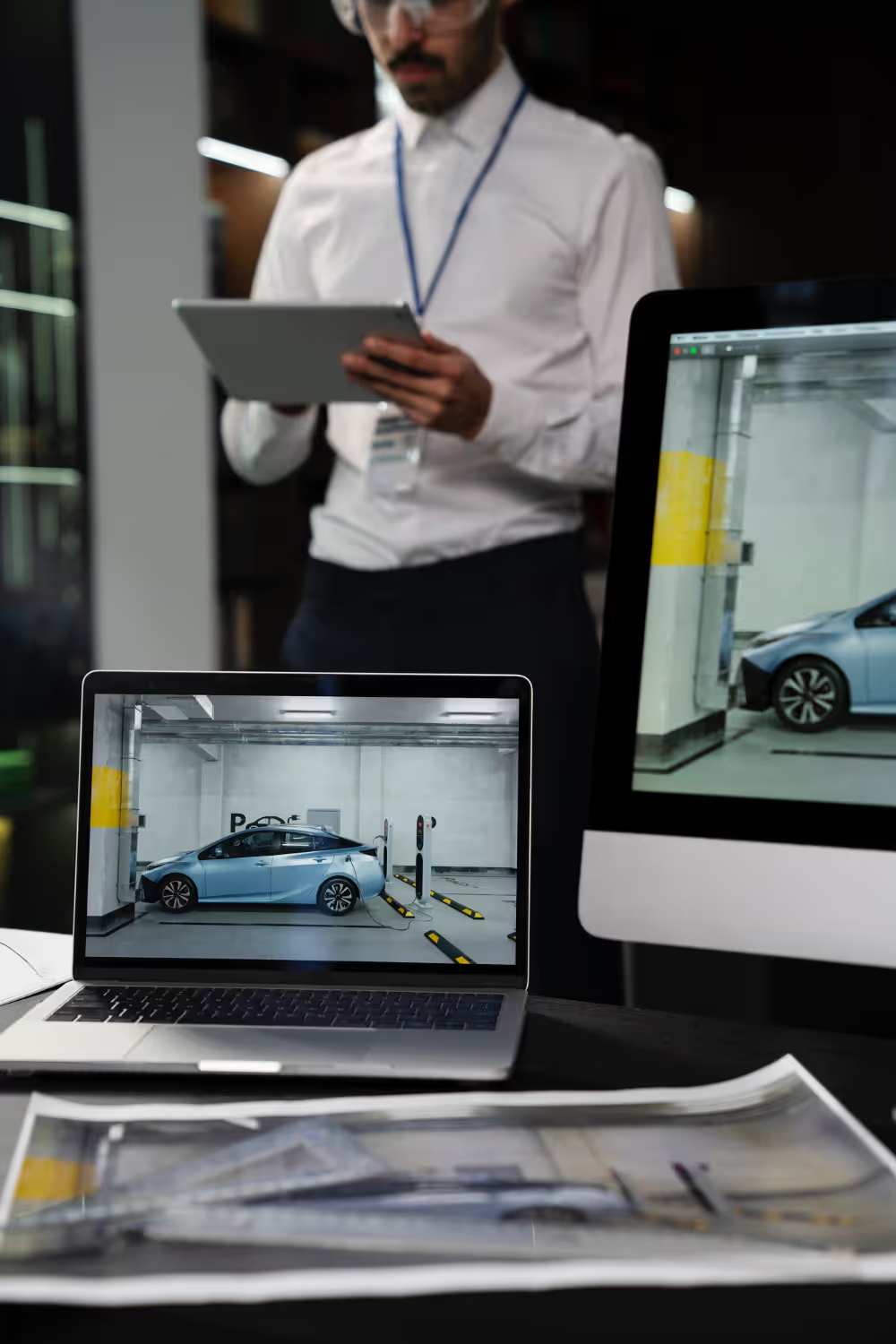
Over-the-Air Updates Cars: New Business Models and Digital Cockpit Technology
Over-the-air updates cars receive transform the relationship between automaker and customer from a one-time transaction into an ongoing service relationship. Through OTA updates automotive systems, vehicles can receive bug fixes, security patches, performance improvements, and entirely new features without visiting a dealership. This capability also enables new business models: features that are physically present in the vehicle but software-locked can be activated through subscriptions or one-time purchases. BMW controversially offered heated seat subscriptions in some markets; other manufacturers are exploring similar approaches for performance upgrades, autonomous driving features, and premium in-car infotainment systems.
The subscription model has generated consumer backlash in some cases, with buyers resenting the idea of paying repeatedly for features their vehicle physically contains. However, the model also enables flexibility: a customer could activate enhanced autonomous driving features for a long road trip without paying for them year-round, or access premium navigation and digital cockpit technology features only when needed. The industry is still experimenting to find the right balance between one-time purchases, subscriptions, and included features that maximizes both revenue and customer satisfaction while delivering compelling connected car technology experiences.
The Challenge for Traditional Automakers
Software-defined vehicles present enormous challenges for traditional automakers whose core competencies lie in mechanical engineering, manufacturing efficiency, and supply chain management rather than software development. Writing and maintaining the millions of lines of code required for a modern SDV with advanced automotive software platforms demands different skills, different organizational structures, and different development processes than building engines and stamping body panels. Many traditional OEMs have struggled with software initiatives, experiencing delays, cost overruns, and quality problems as they attempt to build capabilities that tech companies have honed for decades.
The gap between traditional and tech-forward OEMs is particularly visible when comparing OTA updates automotive frequencies and feature development speed. Tesla releases major software updates monthly; traditional automakers often update vehicle software only annually or when vehicles visit dealerships. Chinese manufacturers, who entered the market more recently and without legacy systems to maintain, have often developed more sophisticated digital cockpit technology and in-car infotainment systems than their Western competitors. Closing this gap requires not just hiring software engineers but fundamentally transforming corporate cultures built around hardware development cycles and dealer service models — a challenge that defines the automotive industry trends 2026.
Connected Car Technology and Vehicle-to-Everything V2X Communication
Vehicle-to-Everything V2X Communication
Connected car technology has evolved from a convenience feature — streaming music, smartphone integration — into a fundamental capability enabling safety systems, autonomous driving, and new mobility services. Vehicle-to-everything V2X communication allows cars to exchange information with other vehicles (V2V), infrastructure like traffic lights (V2I), pedestrians' smartphones (V2P), and cloud services (V2N). This connected car technology transforms the vehicle from an isolated unit navigating based solely on its sensors into a networked node with awareness extending far beyond what cameras and radar can perceive.
The safety implications of vehicle-to-everything V2X are significant. A connected vehicle can receive warnings about hazards around blind corners, know that a traffic light is about to change before the visual signal, be alerted to emergency vehicles approaching from miles away, and coordinate with other vehicles to merge smoothly. These capabilities complement autonomous driving systems: while sensors tell the vehicle what is immediately around it, V2X connectivity provides information about what lies ahead and what other road users intend to do. The combination of sensing and connected car technology creates situational awareness far exceeding what any individual system could achieve alone.
5G Networks and In-Car Infotainment Systems
5G networks provide the bandwidth, low latency, and connection density that advanced connected car technology applications require. While 4G networks suffice for streaming and basic telematics, applications like real-time HD mapping updates, cloud-based AI processing for autonomous driving, and high-frequency vehicle-to-everything V2X communication demand 5G capabilities. The automotive industry has become a major driver of 5G deployment, with telecommunications companies and automakers partnering to ensure coverage along major highways and in urban areas where connected car technology services are most valuable.
In-car infotainment systems have evolved dramatically with 5G connectivity. Modern digital cockpit technology offers streaming video for passengers (not drivers), cloud gaming, video conferencing, and seamless integration with home and office digital ecosystems. The vehicle is becoming a "third space" between home and work — a connected environment where occupants can be productive, entertained, or simply comfortable during their journey. For autonomous vehicles, this evolution of in-car infotainment systems is even more significant: when driving tasks are handled by the vehicle, occupants will want rich digital experiences powered by advanced digital cockpit technology to fill their time.
Cybersecurity: The Critical Challenge for Connected Car Technology
Connected car technology creates vulnerability. Every digital interface represents a potential attack surface for hackers seeking to steal data, disrupt operations, or in worst cases, take control of vehicle functions. As vehicles become more connected through vehicle-to-everything V2Xsystems and more autonomous, the consequences of successful cyberattacks grow more severe. Regulatory frameworks like UNECE R155/R156 and standards such as ISO/SAE 21434 now require automakers to implement comprehensive cybersecurity measures throughout the vehicle lifecycle, from design through end-of-life.
Automotive cybersecurity has evolved from an afterthought to a fundamental design requirement for all connected car technology. Modern vehicles include intrusion detection systems, secure boot processes, encrypted communications for V2X and OTA updates automotive systems, and regular security updates delivered over-the-air. Automakers employ ethical hackers to find vulnerabilities before malicious actors do, and bug bounty programs incentivize the security research community to report problems responsibly. Despite these efforts, the attack surface continues expanding with each new connected feature, making cybersecurity an ongoing battle rather than a problem that can be definitively solved.
| Technology Trend | Current State (2026) | Key Challenge | Expected Timeline |
| Battery EVs | Growing but facing headwinds | Cost, infrastructure, range anxiety | Mainstream by 2030 |
| Solid-State Batteries | Pre-production prototypes | Manufacturing scale, cost | Limited production 2027-2028 |
| Level 3 Autonomy | Mercedes, BMW in limited areas | Regulatory approval, liability | Broader availability 2027+ |
| Software-Defined Vehicles | Tesla leads; others catching up | Legacy systems, talent gap | Industry standard by 2028 |
| 5G Connectivity | Premium vehicles equipped | Network coverage, cost | Standard equipment by 2027 |
| V2X Communication | Pilot deployments | Infrastructure, standardization | Widespread 2028-2030 |
Artificial Intelligence: The Brain Behind the Revolution
AI in Vehicle Design and Manufacturing
Artificial intelligence has penetrated every aspect of the automotive value chain, from initial design through manufacturing to the driving experience itself. In design, generative AI tools help engineers explore thousands of potential configurations for components, optimizing for weight, strength, cost, and manufacturability simultaneously. AI-powered simulation reduces the need for physical prototypes, accelerating development timelines while reducing costs. Digital twins — AI-powered virtual replicas of vehicles and manufacturing facilities — enable engineers to test and refine designs in virtual environments before committing to physical production.
Manufacturing facilities increasingly rely on AI for quality control, predictive maintenance, and process optimization. Computer vision systems inspect components and assemblies with accuracy exceeding human inspectors, identifying defects too subtle for the human eye. Machine learning algorithms predict when equipment will fail, enabling maintenance before breakdowns occur and reducing costly production interruptions. Robots guided by AI handle tasks requiring adaptability that traditional automation couldn't manage, from installing flexible components to adapting production lines for multiple vehicle variants.
AI in the Driving Experience
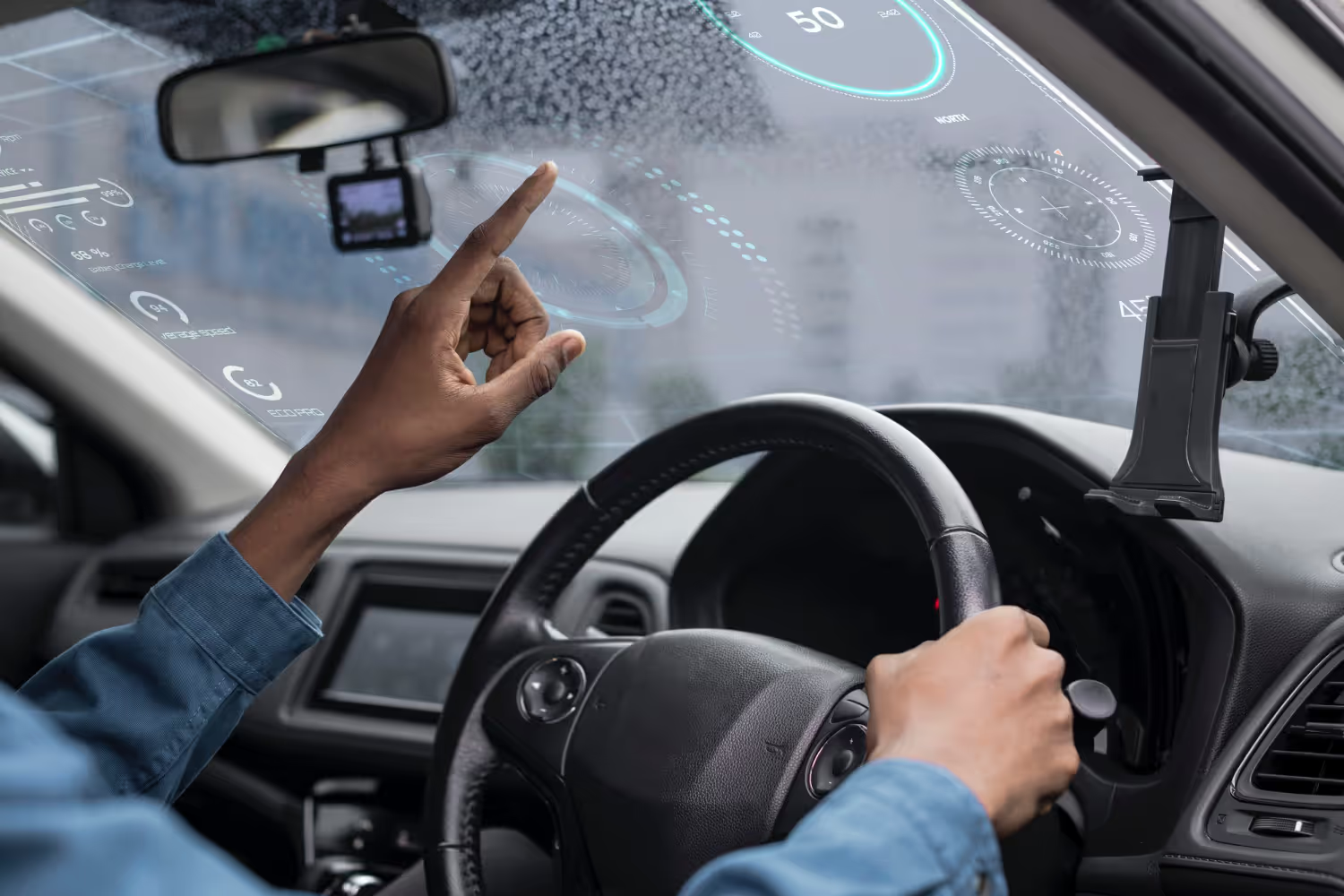
Inside vehicles, AI enables increasingly sophisticated user experiences. Voice assistants powered by large language models understand natural language with unprecedented accuracy, allowing drivers to control vehicle functions, get information, and manage communications through conversation rather than button presses or touchscreen interactions. These systems learn individual preferences, adjusting climate, seating, music, and routing based on context — who is driving, where they're going, what time it is, and patterns from previous trips.
Driver monitoring systems use AI to assess attention, fatigue, and impairment. Cameras track eye movement, head position, and facial expressions; AI interprets these signals to determine whether the driver is alert and focused. These systems are essential for Level 2+ and Level 3 autonomous features that require drivers to remain available as backups. When the system detects distraction or drowsiness, it can alert the driver, reduce autonomous functionality, or in extreme cases, bring the vehicle to a safe stop. The same technology enables personalization: the vehicle can recognize who is driving and automatically apply their preferences.
AI and Autonomous Driving
Autonomous driving systems are fundamentally AI applications — neural networks trained on millions of miles of driving data to recognize objects, predict behavior, and make driving decisions. The industry has largely converged on end-to-end learning approaches where AI systems learn to drive by observing human drivers and receiving feedback on their decisions, rather than following explicit programmed rules for every situation. This approach has proven more capable of handling the infinite variety of situations vehicles encounter in the real world — construction zones, unusual road markings, unexpected pedestrian behavior, adverse weather — though it also makes system behavior less predictable and harder to validate through traditional testing methods.
The quality and quantity of training data has become a key competitive differentiator in autonomous driving development. Companies with large deployed fleets — Tesla with millions of vehicles collecting data worldwide, Chinese manufacturers with massive domestic markets generating billions of miles of real-world driving data — can collect more data more quickly than competitors, potentially creating a widening capability gap. Waymo's robotaxi fleet has accumulated over 20 million autonomous miles; Tesla claims its fleet has driven billions of miles on Autopilot. This data advantage may prove more important than any single algorithmic breakthrough, as AI systems generally improve with more training data.
The industry is grappling with profound questions about how autonomous driving AI should be developed, validated, and regulated. Should safety-critical AI systems be required to explain their decision-making processes, even if this reduces performance? How should edge cases — rare situations that may never have appeared in training data — be handled? What level of safety is "good enough" for deployment, and who decides? These questions have regulatory implications that could shape how autonomous driving technology develops differently in various markets. China is moving aggressively to enable autonomous vehicle deployment; Europe is proceeding more cautiously with comprehensive regulatory frameworks; the United States has taken a largely hands-off approach that allows innovation but creates legal uncertainty.
The Supply Chain Challenge: Semiconductors and Beyond
The Ongoing Chip Shortage
The automotive semiconductor shortage that emerged during the COVID-19 pandemic has evolved but not disappeared. While acute shortages of basic microcontrollers have eased, new constraints have emerged as vehicles demand more sophisticated chips. Modern vehicles may contain over 3,000 chips; electric vehicles and those with advanced autonomous features require even more. The shift toward AI-powered features has created new demand for high-performance computing chips, graphics processors, and memory that the automotive supply chain was not designed to provide.
The industry is transitioning from traditional silicon to advanced materials like silicon carbide (SiC) and gallium nitride (GaN), which enable more efficient power electronics essential for EV performance. This transition requires new manufacturing capacity that takes years to build. Meanwhile, competition from other industries — particularly AI data centers, which offer higher margins and purchase volumes — diverts chip manufacturing capacity away from automotive applications. Automakers are responding by forming direct partnerships with semiconductor manufacturers, investing in chip companies, and in some cases, developing their own chip design capabilities.
Supply Chain Resilience and Regionalization
The vulnerabilities exposed by pandemic disruptions and geopolitical tensions have prompted fundamental reconsideration of automotive supply chains. The just-in-time manufacturing model that minimized inventory costs assumed reliable global logistics and stable political relationships — assumptions that have proven fragile. Automakers are now building inventory buffers, diversifying supplier bases, and in many cases, bringing production closer to end markets even when this increases costs.
Regionalization has accelerated, with manufacturing investments following political incentives as much as economic optimization. The U.S. Inflation Reduction Act has driven battery and EV manufacturing investments to North America. European regulations favor domestic production. Chinese manufacturers are establishing facilities outside China to serve markets increasingly wary of supply chain concentration. The result is a more distributed, potentially more resilient, but also more expensive global manufacturing footprint.
💡 Key Insight — Nearshoring as Design Rule: Supply chain resilience has evolved from sourcing strategy to design constraint. New vehicle programs now consider component availability and supply chain geography during initial design — not as afterthought during production. This shift adds cost but reduces the devastating production stoppages that plagued the industry in recent years.
The Future: What Comes After 2026
Emerging Mobility Models
The technologies transforming vehicles are also transforming how people use them. Subscription services offer access to vehicles without ownership commitment. Robotaxi services, while still geographically limited, demonstrate a future where transportation is purchased per trip rather than per vehicle. Shared mobility platforms coordinate multiple transportation modes — private vehicles, public transit, bikes, scooters — into unified journeys optimized for time, cost, and convenience. These models challenge the century-old assumption that personal transportation means personally owned vehicles.
For automakers, these shifts create both threats and opportunities. If people buy fewer vehicles, focusing instead on transportation services, traditional sales models suffer. But those same people still need vehicles — vehicles that might be optimized for fleet service rather than individual ownership, that might be used more intensively and replaced more frequently, and that might generate ongoing service revenue rather than one-time purchase revenue. Automakers are experimenting with new business models, from manufacturer-operated subscription services to partnerships with ride-hailing platforms to development of purpose-built robotaxi vehicles.
Sustainability and Circular Manufacturing
Environmental pressures extend beyond electrifying powertrains to encompass the entire vehicle lifecycle. Circular manufacturing principles — designing for recyclability, using recycled materials, refurbishing and reusing components — are moving from corporate sustainability reports into production reality. Renault's "Refactory" in France demonstrates industrial-scale vehicle refurbishment and battery recycling. BMW's new manufacturing facilities are designed for carbon-neutral operation. Regulations increasingly measure carbon per vehicle, not just tailpipe emissions, pushing manufacturers to consider the environmental impact of materials, manufacturing, and end-of-life disposal.
Battery recycling and second-life applications have become significant business opportunities as the first generation of mass-market EVs ages. Batteries that no longer meet automotive performance requirements often retain substantial capacity for stationary energy storage applications. Extracting and refining valuable materials from spent batteries reduces dependence on mining and improves the lifecycle economics of electrification. These emerging industries are attracting investment and creating new value chains that didn't exist a decade ago.
Conclusion: Navigating the Automotive Technology Trends 2026
The automotive industry trends 2026 reveal a sector that bears little resemblance to the industry of even a decade ago, and the pace of change shows no signs of slowing. Electric vehicles 2026, autonomous capabilities, software-defined vehicles, connected car technology, and artificial intelligence are not separate trends but interconnected elements of a comprehensive transformation that touches every aspect of how vehicles are designed, manufactured, sold, used, and eventually recycled. Companies that successfully integrate these automotive technology trends 2026 will thrive; those that fail to adapt will struggle to survive in an industry being reshaped by competitors from outside traditional automotive circles.
For consumers, the future of automotive technology brings both opportunities and challenges. Vehicles are becoming safer, with ADAS features preventing thousands of accidents annually and autonomous capabilities promising even greater safety improvements as they mature. They are becoming more capable, with over-the-air updates cars receive adding features that weren't available when the vehicle was purchased. They are becoming more connected through vehicle-to-everything V2X systems, serving as mobile offices, entertainment centers, and seamless extensions of digital lives. And they are becoming more environmentally responsible, with EV technology trends dramatically reducing lifetime emissions even accounting for battery technology for electric vehicles production. At the same time, complexity is increasing, pricing remains high, and the car technology trendslandscape can be confusing to navigate.
Understanding the underlying automotive technology trends 2026 — their current state, their trajectories, and their limitations — helps consumers make informed decisions about significant purchases that will serve them for years to come. The vehicle purchased today will exist in a very different technological environment five years from now; choosing vehicles with automotive software platforms that can evolve through OTA updates automotive technology provides some protection against rapid obsolescence. Understanding what autonomous features actually do, rather than what their names imply, helps set appropriate expectations and use these systems safely. Recognizing that EV charging technology and fast charging EVinfrastructure continues improving helps evaluate whether electric car technology suits current needs.
The winners in this transformation will be those who recognize that automotive excellence is being redefined by the automotive innovation 2026wave. Mechanical quality and manufacturing efficiency remain important, but they are now table stakes rather than differentiators. The vehicles that capture consumer enthusiasm and market share will be those that deliver compelling digital cockpit technology experiences, that improve continuously through over-the-air updates carsreceive, that integrate seamlessly into digital lives through advanced in-car infotainment systems, and that offer the safety and convenience of advanced automation. The future of automotive technology will be as different from its past as automobiles were from the horses they replaced — and that transformation is happening now.
Related Stories
Read more
Read more