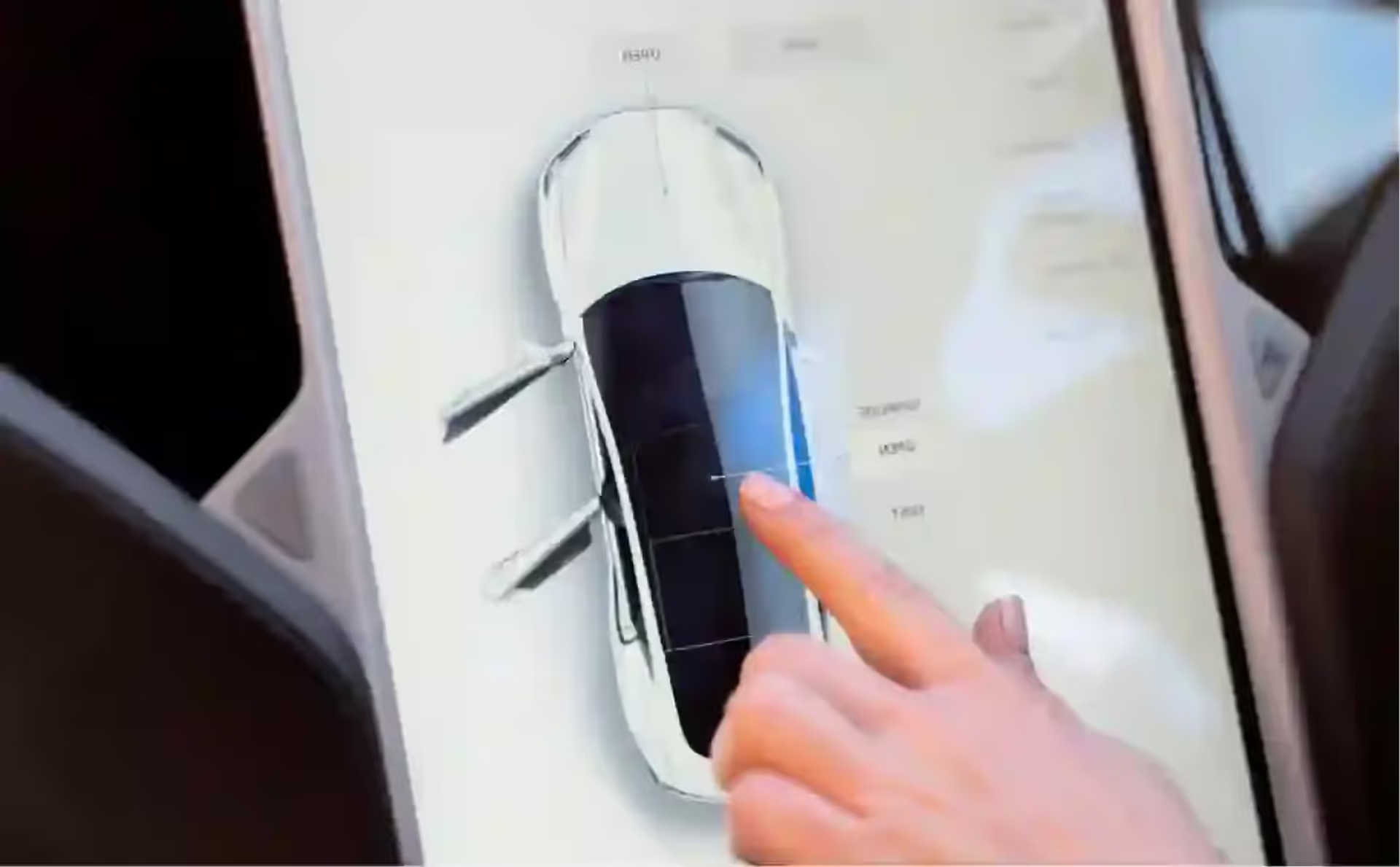
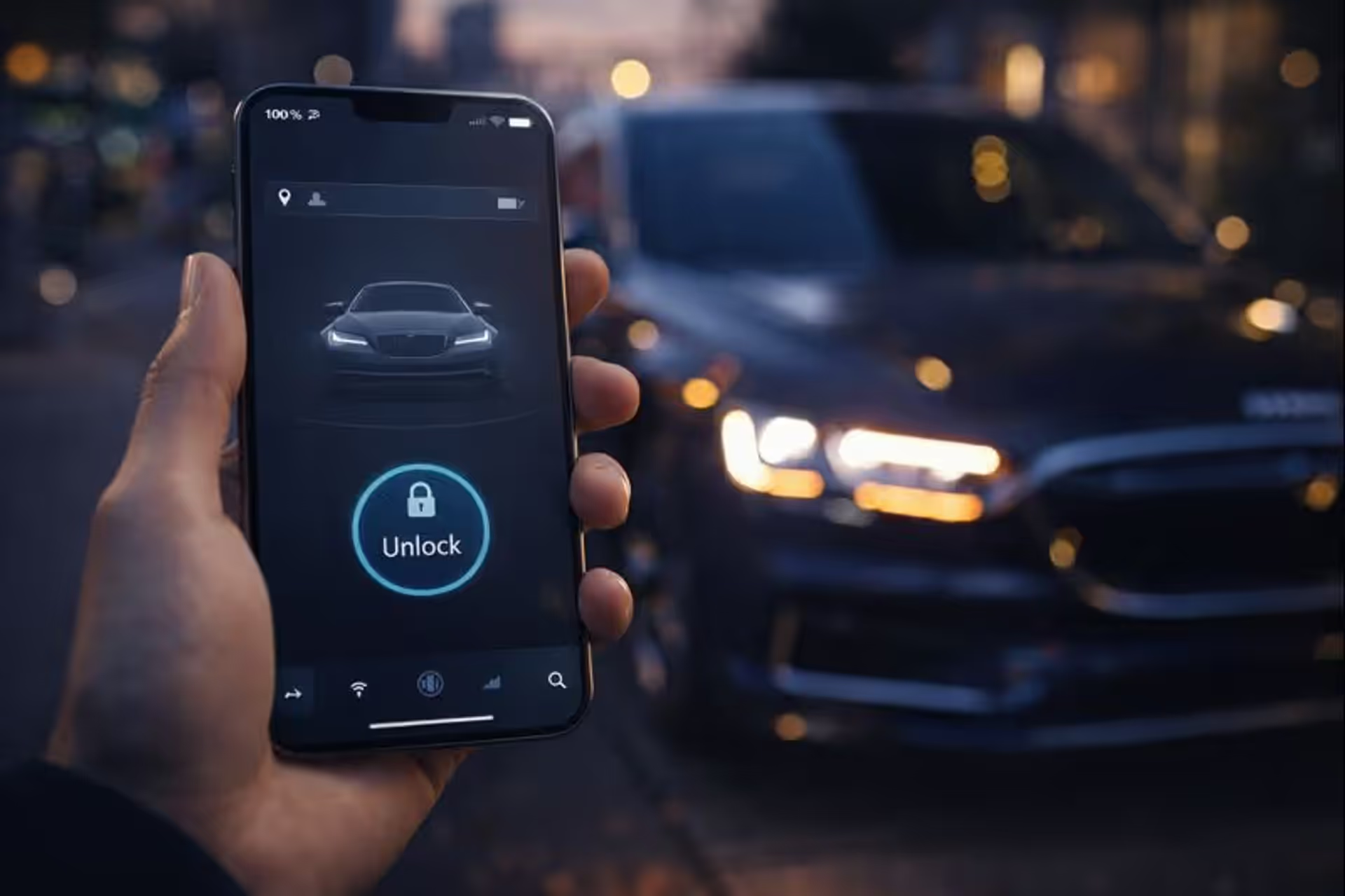
Your pocket holds the key to everything.
Digital Keys and Smartphone Integration: How Your Phone Is Becoming the Car Key

Introduction: The End of the Physical Key
The car key — that small piece of metal and plastic that has lived in pockets, purses, and on hooks by front doors for over a century — is disappearing. Not evolving, not shrinking, not becoming smarter while remaining physically present. Disappearing entirely, replaced by something most drivers already carry everywhere: their smartphone.
This transformation represents more than mere convenience. The shift to digital car keys fundamentally reimagines vehicle access, ownership, and the relationship between driver and machine. A traditional key is binary — you have it or you don't, you can start the car or you can't. A digital key for cars exists as software, infinitely copyable, remotely manageable, and capable of intelligence that physical objects cannot possess. The implications ripple through vehicle security, sharing, rental, fleet management, and the very concept of what it means to have access to a car.
The smartphone car integration enabling this transformation builds on capabilities developed over the past decade. Modern vehicles already connect to phones for audio, navigation, and communication. The extension to vehicle access represents a logical progression — if the phone can control the stereo, why not the locks? If it can display the car's location, why not unlock the doors? The technological foundation exists; what changes is the application.
Yet the transition involves complexities invisible to users enjoying seamless mobile phone car integration. Security architectures must protect against digital threats that physical keys never faced. Standardization efforts coordinate competing manufacturers toward interoperable systems. User experience design must make phone as car key technology feel as natural and reliable as the metal keys it replaces. The ecosystem supporting digital vehicle access spans automakers, phone manufacturers, telecommunications providers, and security specialists in ways that simple mechanical keys never required.
"The smartphone becoming the car key isn't really about the key — it's about the relationship between driver and vehicle becoming software-mediated rather than hardware-mediated," observes an automotive connectivity strategist. "Everything changes when that relationship moves into the digital domain."
This analysis examines the technology enabling digital keys, the security frameworks protecting them, and the ecosystem of connected car apps and platforms that integrate vehicle access into broader connected mobility experiences. Understanding these dynamics illuminates not just how we'll unlock cars in the future, but how the entire concept of vehicle access is being reimagined.
How Digital Car Keys Work
The digital car key system replacing physical keys combines multiple technologies working in concert — short-range wireless communication, cryptographic security, cloud connectivity, and sophisticated user interface design. Understanding how these elements interact reveals both the elegance and complexity of modern smartphone car key technology.
The Communication Layer: UWB, NFC, and Bluetooth
Digital keys require communication between phone and vehicle, creating the connection that authenticates access requests and triggers lock or unlock actions. Three wireless technologies dominate current implementations, each with distinct characteristics that suit different use cases.
Ultra-Wideband (UWB) technology has emerged as the premier solution for advanced keyless entry in premium implementations. UWB transmits across a wide frequency spectrum using very short pulses, enabling precise distance measurement between phone and vehicle with centimeter-level accuracy. This precision prevents relay attacks — where criminals amplify signals from a distant key to fool the car into thinking the key is nearby — because UWB can verify that the phone is actually within physical proximity rather than merely receiving a relayed signal. Apple's CarKey implementation and the Car Connectivity Consortium's Digital Key 3.0 standard both specify UWB for this reason.
Near Field Communication (NFC) provides a simpler, more established approach for mobile phone keyless car access. NFC requires the phone to be within centimeters of a reader — typically a sensor on the door handle or B-pillar — to establish communication. This close-range requirement provides inherent security against relay attacks, as the phone must be physically present rather than merely in radio contact. NFC's widespread deployment in payment systems has established user familiarity with tap-to-unlock gestures, easing adoption for vehicle access.
Bluetooth Low Energy (BLE) enables smartphone remote vehicle access at greater distances than NFC allows, supporting hands-free access where the car unlocks as the owner approaches without requiring phone retrieval from pocket or bag. BLE's power efficiency suits always-on monitoring for proximity detection. However, BLE alone lacks the precise ranging that UWB provides, making it more vulnerable to relay attacks if not combined with additional security measures.
Current best practice combines multiple technologies — using BLE for initial presence detection, NFC or UWB for precise authentication at the moment of access, and cellular connectivity for remote operations when out of direct range. This layered approach provides the convenience users expect while maintaining security against varied attack vectors.
The Security Architecture
The digital car key security protecting vehicle access from unauthorized use involves cryptographic systems of considerable sophistication. The stakes are high — compromised vehicle security exposes owners to theft, privacy violation, and potentially physical danger — driving security implementations that rival banking and government systems.
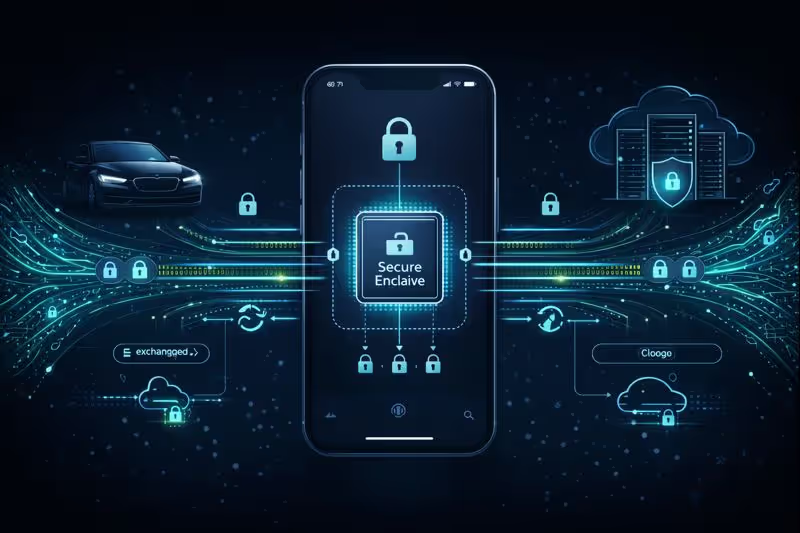
The Digital Key standard developed by the Car Connectivity Consortium establishes security requirements that compliant implementations must meet. Keys are stored in secure elements — tamper-resistant hardware within the phone designed specifically for cryptographic operations. The iPhone's Secure Enclave and Android's Trusted Execution Environment provide these capabilities, isolating key material from the main operating system where malware might access it.
Authentication between phone and vehicle uses asymmetric cryptography — mathematical systems where proving possession of a private key establishes identity without revealing the key itself. The vehicle stores the public key; the phone holds the corresponding private key in its secure element. Each access attempt involves cryptographic challenge-response protocols that verify key possession without exposing key material to interception.
The encrypted car access technology protecting communication between phone and vehicle prevents eavesdroppers from capturing authentication exchanges and replaying them later. Each session uses unique encryption keys derived through secure key exchange protocols. Even intercepting every byte of communication reveals nothing useful to attackers lacking the underlying private keys.
Cloud components introduce additional security considerations. The infrastructure enabling remote car access appfunctionality — checking vehicle status, locking or unlocking remotely, sharing access with others — requires secure communication with manufacturer servers that mediate between phones and vehicles. These systems must resist attacks on servers themselves, on communication channels, and on the administrative interfaces through which operators manage the infrastructure.
The User Experience of Keyless Access
The success of keyless entry technology depends ultimately on user experience — whether the technology feels natural, reliable, and effortless compared to the physical keys it replaces. The engineering challenge involves making sophisticated technology invisible, creating experiences so seamless that users forget technology is involved at all.
Passive Entry and Walk-Up Unlock
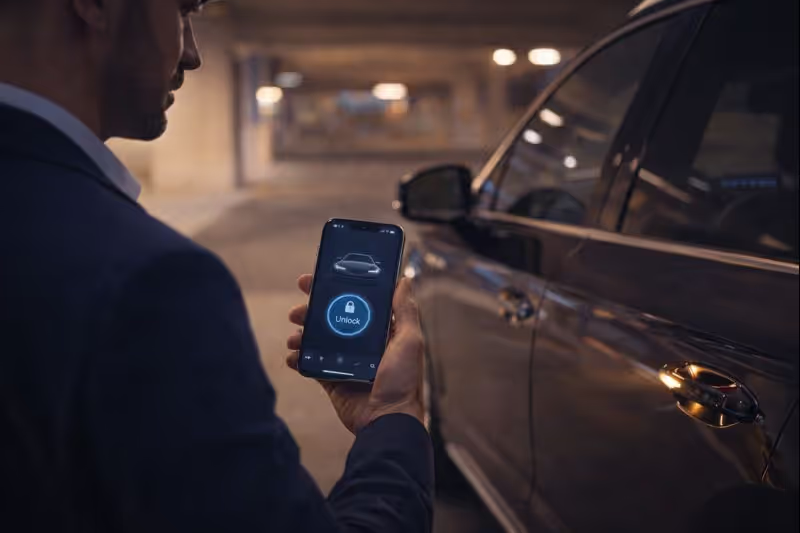
The premium implementation of smart key technology enables passive entry — the vehicle unlocks automatically as the authenticated owner approaches, without requiring phone retrieval or any explicit action. The experience mirrors what sophisticated traditional key fobs have provided for years, extended now to the phone already in pocket or bag.
Implementing passive entry reliably requires solving several technical challenges. The system must detect approach accurately, distinguishing the owner walking toward the car from the owner walking past it on an adjacent sidewalk. It must unlock at the appropriate moment — not so early that the car sits unlocked while the owner is still distant, not so late that the owner reaches for a locked door. It must work consistently across varied conditions — different pockets and bags affecting signal strength, different phone positions affecting detection geometry, different environmental conditions affecting wireless propagation.
The UWB technology increasingly adopted for next generation car access addresses these challenges through precise spatial awareness. Rather than simply detecting the phone's presence in some radius around the vehicle, UWB determines the phone's position with sufficient accuracy to understand approach direction, velocity, and likely intent. This spatial intelligence enables smarter behavior — unlocking only the driver's door when approaching from that side, unlocking all doors when approaching from the rear with shopping bags, remaining locked when walking past on adjacent sidewalks.
Active Unlock and Authentication
When passive entry isn't appropriate or isn't available, smartphone controlled car access requires explicit user action. The gesture design for this interaction significantly affects perceived convenience and security.
NFC-based systems typically require tapping the phone against a designated sensor location — often on the door handle, B-pillar, or a marked spot on the exterior. This tap-to-unlock gesture mirrors payment experiences familiar to most smartphone users, leveraging learned behavior to ease adoption. The gesture's explicit nature provides security through intentionality — accidental unlocks are nearly impossible when physical contact is required.
App-based unlock provides an alternative for situations where NFC tap is inconvenient — hands full, phone in deep bag, or simply user preference. The connected car apps provided by manufacturers typically include lock and unlock controls prominently featured on main screens, enabling vehicle control with minimal navigation. Premium implementations add widgets and watch apps that surface these controls for fastest possible access.
Biometric integration strengthens security while streamlining experience. Requiring Face ID or fingerprint authentication before transmitting unlock commands ensures that stolen phones cannot access vehicles without also defeating biometric security. This layered protection means that losing a phone doesn't automatically mean losing vehicle security — a significant advantage over traditional keys that grant access to whoever possesses them.
Key Sharing and Access Management
Perhaps the most transformative capability of digital key for cars systems is the ability to share vehicle access digitally — granting, modifying, and revoking access rights through software rather than physical key exchange. This capability reimagines scenarios from lending a car to a friend to managing commercial fleet access.
Personal Key Sharing
Traditional key sharing requires physical handoff — meeting the borrower to pass them a key, coordinating return to get it back. Virtual car key technology enables sharing through messaging apps, email, or proprietary sharing interfaces without physical meeting. The owner sends a digital key; the recipient installs it on their phone; they gain vehicle access limited by whatever restrictions the owner specifies.
The granularity of sharing permissions represents a genuine advance over physical key capabilities. An owner lending their car can restrict access to specific time windows — the weekend only, business hours only, or specific dates. They can limit functionality — allowing door access but not engine start, enabling driving but disabling certain vehicle functions. They can set geographic boundaries, receiving alerts if the vehicle leaves designated areas. These controls, impossible with physical keys, enable confident sharing that owners might otherwise decline due to control concerns.
The experience design for sharing matters significantly. Apple's implementation integrates with iMessage, enabling key sharing through the same interface used for casual communication. Android implementations use various mechanisms depending on manufacturer and phone model. The car companion apps from automakers provide proprietary sharing interfaces that work across phone platforms but require app installation and account creation. The friction involved in sharing affects how readily owners use the capability — seamless sharing encourages use, cumbersome processes deter it.
Commercial and Fleet Applications
The automotive access control systems enabled by digital keys transform commercial vehicle management. Fleet operators can provision access for drivers without physical key distribution, modify access as assignments change, and revoke access instantly when employees depart. The administrative overhead of managing physical keys — tracking who has which key, retrieving keys from departing staff, rekeying vehicles when keys are lost — largely disappears.
Rental car operations benefit particularly from mobile car access capabilities. Customers arriving at airport locations can proceed directly to vehicles without queuing at counters, using digital keys pushed to their phones during the reservation process. Keys expire automatically at rental end, eliminating return check-in while ensuring that departed renters cannot access vehicles. The friction reduction improves customer experience while reducing operational costs.
Car sharing services depend fundamentally on digital access capabilities. Services like Zipcar and Turo cannot function economically if every access requires physical key handoff; digital keys enable the spontaneous, short-duration access patterns that define car sharing. The vehicle connectivity platforms underlying these services manage millions of access credentials, provisioning and revoking dynamically as reservations begin and end.
Table 1: Digital Key Sharing Capabilities and Use Cases
| Use Case | Access Duration | Typical Restrictions | Key Revocation | Primary Technology |
| Family Member | Permanent | None or minimal | Manual, rare | Full digital key |
| Friend Borrowing | Hours to days | Time window, sometimes geo | Automatic at expiration | Limited digital key |
| Valet Parking | Minutes to hours | Speed limits, distance limits, no trunk | Automatic at expiration | Restricted valet key |
| Car Rental | Days to weeks | Contract terms | Automatic at end | Time-limited full key |
| Car Sharing | Hours | Service terms | Automatic at end | Platform-managed key |
| Fleet Vehicle | Per assignment | Driver credentials | Instant on reassignment | Enterprise-managed key |
The Connected Car Ecosystem
Digital keys exist within a broader ecosystem of connected vehicle apps and platforms that extend smartphone integration far beyond basic access. Understanding this ecosystem reveals how vehicle access becomes one capability among many in increasingly connected automotive experiences.
Manufacturer Apps and Platforms
Every major automaker now provides automotive mobile apps enabling owners to interact with vehicles remotely. These apps typically consolidate multiple functions — vehicle access, status monitoring, climate pre-conditioning, location tracking, maintenance scheduling, and service communication — into unified interfaces that serve as primary touchpoints between owners and brands.
The connected car apps from premium manufacturers set expectations that mainstream brands increasingly meet. BMW's My BMW app, Mercedes me, Audi myAudi, and comparable offerings from other premium brands provide comprehensive remote capabilities that have migrated down-market as technology costs decline and consumer expectations rise. A vehicle without substantial app functionality increasingly seems incomplete, regardless of segment positioning.
The automotive software platforms underlying these apps involve significant infrastructure investment. Cloud services must handle millions of vehicles communicating status, receiving commands, and managing credentials. Security infrastructure must protect against attacks targeting this large attack surface. Update mechanisms must distribute new capabilities while maintaining stability. The platform engineering required rivals that of major consumer software companies, driving partnerships between automakers and technology specialists.
Third-party integrations extend manufacturer apps into broader connected ecosystems. Smart home platforms like Apple HomeKit, Google Home, and Amazon Alexa can incorporate vehicle control — unlocking the car when the alarm is disarmed, starting climate control when leaving the house, reporting vehicle location in response to voice queries. These integrations position the connected car as one element of increasingly automated daily routines.
Vehicle Connectivity Platforms
Beneath manufacturer-branded apps, vehicle connectivity platforms from technology providers enable the communication and data management that connected services require. Companies including Harman, Bosch, Continental, and AWS provide infrastructure that automakers build upon rather than creating from scratch.
These platforms handle the complexity of maintaining persistent connections with millions of vehicles, managing the data those connections generate, and enabling the services that data supports. The automotive iot solutions underlying connected cars must address automotive-specific requirements — long vehicle lifetimes measured in decades, harsh operating environments, safety-critical reliability requirements — that general-purpose IoT platforms don't automatically provide.
The car iot features enabled by these platforms extend beyond owner-facing apps to include manufacturer analytics, predictive maintenance, over-the-air updates, and increasingly, data monetization. The connected car generates substantial data about usage patterns, driving behavior, and vehicle condition; platforms that manage this data enable services that exploit it for value creation — with implications for privacy that regulators increasingly address.
Security Challenges and Responses
The transition from physical to digital vehicle access introduces security challenges that physical keys largely avoided. The convenience of software-defined access comes with exposure to software-defined attacks. Understanding these challenges and the responses addressing them illuminates why vehicle access security receives such intensive attention.
Attack Vectors and Countermeasures
The automotive cybersecurity access landscape includes attack vectors that exploit different system components. Each vector requires specific countermeasures, creating layered defense that provides security even when individual layers are compromised.
Relay attacks amplify wireless signals from legitimate keys to fool vehicles into unlocking for distant attackers. Traditional key fobs proved vulnerable when criminals with signal amplifiers could relay signals from keys inside homes to cars in driveways. Secure keyless car entry using UWB defeats relay attacks through precise ranging — the vehicle knows the phone's actual distance, not just signal presence, making amplified signals useless.
Phishing attacks target account credentials that control digital key management. An attacker who compromises the owner's automaker account might add unauthorized digital keys or modify existing permissions. Strong authentication — multi-factor authentication, biometric verification for sensitive operations — protects against credential compromise. Rate limiting and anomaly detection identify suspicious activity that might indicate compromised accounts.
Man-in-the-middle attacks attempt to intercept and manipulate communication between phone and vehicle. End-to-end encryption with certificate verification prevents meaningful interception — attackers might capture encrypted traffic but cannot decrypt or modify it without detection. The encrypted car access technology protecting these communications uses the same cryptographic primitives that secure financial transactions and military communications.
Physical attacks on phone secure elements attempt to extract stored keys through sophisticated hardware analysis. The secure enclave implementations in modern phones are designed to resist such attacks, destroying key material if tampering is detected. The security investment that phone manufacturers make to protect payment credentials simultaneously protects digital car keys.
Standards and Certification
The fragmented landscape of proprietary digital key implementations creates interoperability challenges and uneven security practices. Industry standards and certification programs address these issues, establishing common requirements that enable cross-manufacturer compatibility while ensuring baseline security.
The Car Connectivity Consortium's Digital Key specification has emerged as the primary standard, supported by major automakers and phone manufacturers including Apple, Google, Samsung, and others. The specification defines communication protocols, security requirements, and functional capabilities that compliant implementations must provide. Devices certified against the specification can interoperate regardless of manufacturer, enabling scenarios like using an iPhone to access a BMW or a Samsung phone to unlock a Hyundai.
The security certification process verifies that implementations meet specified requirements through testing and documentation review. Certification provides assurance that devices claiming compliance actually deliver the promised security — important given that security claims are difficult for consumers to verify independently.
"Standardization isn't just about convenience — it's fundamentally about security," explains a connected vehicle security architect. "When everyone implements from the same well-reviewed specification, the entire ecosystem benefits from collective security investment rather than each manufacturer securing alone."
Regional Adoption and Market Dynamics
The adoption of digital car key technology varies across major markets, reflecting different technological ecosystems, regulatory environments, and consumer preferences. Understanding regional patterns illuminates how global deployment is progressing and where remaining barriers exist.
North America: Smartphone Leadership Meets Automotive Tradition
The North American market for smartphone vehicle connectivity benefits from high smartphone penetration, strong consumer interest in technology features, and manufacturer responsiveness to connected vehicle demand. The region's early adoption of smartphone integration technologies like CarPlay and Android Auto established expectations that digital keys extend.
Apple's influence on North American digital key adoption warrants emphasis. The iPhone's dominant position among premium consumers — exactly those most likely to purchase vehicles with digital key capabilities — means that Apple's implementation choices significantly affect market dynamics. Apple's integration of CarKey into iOS, with support for iPhone and Apple Watch, created an installed base of hundreds of millions of devices capable of digital key functionality pending vehicle support.
The diversity of vehicle age in North American fleets creates adoption challenges. Vehicles average over twelve years old; digital key functionality requires relatively recent production with appropriate hardware. Market penetration for digital keys will increase gradually as older vehicles retire and new purchases replace them — a transition measured in years rather than months.
Europe: Regulatory Attention and Premium Heritage
European markets combine strong connected vehicle interest with regulatory attention to security and privacy that shapes implementation approaches. The premium German brands leading digital key deployment — BMW, Mercedes-Benz, Audi — serve as technology trendsetters that other manufacturers follow.
The luxury car digital key implementations from German manufacturers typically represent the technology frontier, incorporating latest standards and most sophisticated security approaches. BMW's Digital Key Plus, using UWB for precise ranging and relay attack prevention, exemplifies premium implementation that eventually cascades to broader deployment.
European regulatory frameworks address digital identity and electronic signatures in ways that affect digital key implementations. The eIDAS regulation establishing standards for electronic identification influences how digital keys interact with broader identity infrastructure. Privacy regulations under GDPR affect how connected vehicle platforms handle the personal data that digital key usage generates.
China: Rapid Deployment and Ecosystem Integration
The Chinese market demonstrates aggressive digital key adoption, driven by domestic manufacturers deploying advanced connectivity features as competitive differentiators and by consumers highly comfortable with smartphone-mediated services. The ecosystem integration characteristic of Chinese mobile commerce extends readily to vehicle access.
Domestic phone manufacturers including Xiaomi, Huawei, and others have developed digital key capabilities that work with Chinese automakers' vehicles, creating regional ecosystems that operate somewhat independently of the Apple/Google-dominated Western markets. This fragmentation creates challenges for global automakers who must support multiple digital key ecosystems to serve all markets effectively.
The integration of vehicle access with broader mobility services proves particularly advanced in China. Super-apps that consolidate payment, transportation, services, and communication incorporate vehicle access as one capability among many. A user who hails a ride, pays for parking, and unlocks their own car through the same app interface experiences a continuity of experience that more fragmented Western ecosystems don't yet provide.
The Future of Vehicle Access
The trajectory of future of car keys technology points toward increasingly seamless, secure, and intelligent access experiences. Understanding this trajectory helps stakeholders — from manufacturers to consumers — anticipate how vehicle access will continue evolving.
Biometric Vehicle Access
While current digital keys authenticate the phone and assume the phone's holder is authorized, future systems may authenticate the person directly through biometrics. A vehicle that recognizes its owner's face, voice, or other biometric characteristics could unlock without requiring phone or key presence at all — the ultimate in seamless access.
Automotive biometric implementation involves challenges beyond those familiar from phone biometrics. Recognition must work across varied conditions — different lighting, weather, approach angles — that phone face recognition doesn't encounter. Privacy implications of vehicles storing biometric data require careful consideration and likely regulatory attention. The fallback mechanisms when biometric recognition fails must provide security without excessive friction.
Premium vehicles increasingly incorporate driver monitoring systems using cameras that track attention and fatigue. These same cameras could support face recognition for access authentication, adding capability without additional hardware. The convergence of safety-focused monitoring with security-focused biometrics seems likely as the underlying technology matures.
Vehicle-to-Infrastructure Integration
The connected vehicle's communication capabilities extend beyond phone interaction to enable integration with broader infrastructure. Automotive iot solutions connecting vehicles with parking structures, charging stations, payment systems, and urban infrastructure create experiences where vehicle access becomes one element of seamlessly connected mobility.
A vehicle that authenticates to a parking structure based on approaching the gate, debits parking fees from a linked payment method, and records entry/exit automatically eliminates friction that physical tickets or manual payment creates. Charging infrastructure that recognizes vehicles and initiates sessions based on plug connection without separate authentication simplifies the EV ownership experience. These integrations build on the same connected car iotinfrastructure that enables digital keys, extending the benefits of software-defined vehicle identity across broader use cases.
The Subscription and Access Economy
The capabilities that digital keys enable — granular access control, time-limited permissions, remote management — align with economic models that separate access from ownership. Vehicle subscription services, short-term rentals, and car sharing all depend on access management capabilities that digital keys provide naturally but physical keys cannot support economically.
The digital car key ecosystem supporting these models involves coordination among automakers, mobility service providers, and platform operators. A vehicle might grant access through a car-sharing app at one moment, a rental company the next, and the owner's personal device throughout — all managed through the same underlying key infrastructure. This fluidity of access supports business models that couldn't exist with physical key constraints.
"The real transformation isn't the key itself — it's what programmable access enables," notes a mobility services executive. "When access is software, every business model based on controlled vehicle access becomes viable in ways that physical keys never allowed."
Table 2: Digital Key Technology Evolution and Capabilities
| Generation | Period | Core Technology | Security Approach | Key Sharing | Range |
| Gen 1 | 2018-2020 | BLE only | Encryption, rolling codes | Limited/none | ~10m |
| Gen 2 | 2020-2023 | BLE + NFC | Enhanced encryption, secure element | Basic sharing | Proximity + ~10m |
| Gen 3 | 2023-2025 | UWB + NFC + BLE | Precise ranging, anti-relay | Rich sharing, permissions | mm-level precision + ~30m |
| Gen 4 | 2025-2027 | UWB + biometric integration | Multi-factor, behavioral | Granular control, fleet-ready | Extended range + biometric |
| Gen 5 | 2028+ | Biometric primary, multi-modal | Continuous authentication | Seamless, context-aware | Keyless (biometric only option) |
Implementation Considerations for Manufacturers and Developers
The deployment of automotive digital key systems involves decisions affecting security, user experience, and business model that manufacturers and platform developers must navigate. Understanding these considerations illuminates why implementations vary and what trade-offs different approaches represent.
Platform Strategy and Ecosystem Choice
Manufacturers choosing digital key strategies must decide how to balance proprietary differentiation against standardized interoperability. The premium connected car features that distinguish brands argue for proprietary capabilities; the user expectation that phones work with cars argues for standard compliance. Most manufacturers adopt hybrid approaches — implementing standard protocols for basic functionality while adding proprietary extensions for differentiation.
The choice of phone platform support involves similar trade-offs. Supporting only Apple devices excludes Android users — a potentially significant market segment. Supporting both platforms requires implementing for different security architectures, different app stores, and different user experience conventions. The vehicle connectivity platforms that manufacturers develop or adopt must accommodate this multiplatform reality while maintaining security and experience consistency.
Partnership decisions shape capability and timeline. Manufacturers who partner with phone platform providers — Apple, Google — gain access to deep integration capabilities but accept dependency on partners' roadmaps and priorities. Those developing more independently retain control but may lack access to platform capabilities that partnerships would provide. The automotive software platforms enabling digital keys often involve complex partnership structures balancing these considerations.
Security Investment and Risk Management
The security requirements for secure keyless car entry demand investment in expertise, infrastructure, and ongoing vigilance that varies significantly across manufacturers. Premium brands with larger security teams and greater risk awareness typically implement more sophisticated protections; volume brands may face pressure to minimize security investment that doesn't directly drive sales.
Certification against industry standards provides some assurance of baseline security, but certified implementations can still vary in how far they exceed minimums. Consumers cannot easily evaluate security quality, creating potential for market dynamics that don't reward security investment as strongly as visible features. The automotive cybersecurity access ecosystem includes security researchers who evaluate and publicize implementation weaknesses — a dynamic that creates both accountability and reputation risk for manufacturers.
The liability implications of security failures remain incompletely resolved. When digital key vulnerability enables vehicle theft, questions of manufacturer responsibility, platform provider responsibility, and user behavior interact in ways that precedent has not yet clarified. Insurance products are evolving to address these scenarios, but the allocation of risk among ecosystem participants continues developing.
Conclusion: The Key That Isn't There
The transformation from physical to digital car keys represents more than a technology upgrade — it reconceives what vehicle access means and how it functions in increasingly connected lives. The metal key that served for a century is giving way to software that enables capabilities its predecessor couldn't imagine: access that can be shared remotely, permissions that can be precisely controlled, credentials that can be instantly revoked, and experiences that can be seamlessly integrated into digital ecosystems.
The smartphone car integration enabling this transformation builds on infrastructure developed for other purposes — secure elements designed for payments, wireless protocols designed for consumer electronics, cryptographic systems designed for secure communications. The automotive application of these technologies demonstrates how vehicle connectivity leverages rather than reinvents the digital infrastructure that modern life already depends upon.
The security imperative shapes every aspect of digital key implementation. Vehicle access security cannot be an afterthought when the consequences of failure include vehicle theft and potentially personal safety. The layered defenses protecting digital vehicle access — secure elements, encrypted communications, precise ranging, continuous authentication — represent genuine engineering achievement in managing risks that physical keys largely avoided.
The ecosystem surrounding digital keys extends far beyond the access function itself. Connected car apps consolidate remote capabilities from climate control to maintenance scheduling. Vehicle connectivity platforms manage the infrastructure enabling millions of connected vehicles. Sharing capabilities transform personal vehicles into assets that can be readily loaned, rented, or shared. The key is becoming less a discrete object than an entry point into a connected vehicle relationship.
For consumers, the transition promises convenience that improves with each generation — from phones that replace key fobs to passive entry that unlocks automatically to biometric recognition that eliminates devices entirely. Each step reduces friction while maintaining or improving security, creating experiences that will make physical keys seem as antiquated as physical ignition keys already do.
For the automotive industry, digital keys represent both opportunity and challenge. The opportunity lies in connected experiences that strengthen customer relationships and enable new business models. The challenge lies in implementing security rigorously, managing complex ecosystems competently, and navigating a transition where physical and digital keys coexist until the transformation completes.
The future of car keys is, paradoxically, no key at all — at least no physical artifact that can be lost, stolen, or forgotten. The key becomes information, secured by cryptography, mediated by software, and managed through interfaces that integrate vehicle access into the digital lives we already live. The pocket that once held keys now holds a device that provides access to everything — including, increasingly, the car waiting in the driveway.
Related Stories

Read more
Read more