The future charges faster.
The Charging Revolution: Why EV Infrastructure Will Define the Electric Future

Content
Content
Introduction: The Infrastructure Imperative
The electric vehicle revolution has arrived, but it faces an unexpected constraint. After years of focusing on battery range, acceleration times, and vehicle design, the industry has discovered that the limiting factor for mass EV adoption is not the cars themselves — it is the ecosystem that powers them.
EV charging infrastructure has emerged as the critical variable determining whether electric vehicles transition from early-adopter enthusiasm to mainstream transportation. The most impressive electric vehicle means nothing if drivers cannot charge it reliably, quickly, and conveniently. And as global EV sales approach inflection points that will fundamentally reshape automotive markets, the adequacy of charging networks has become the question that matters most.
This reality represents a significant shift in how we understand the electric transition. For years, the narrative centered on vehicles: longer ranges, faster charging acceptance rates, lower prices, better performance. These improvements have materialized impressively. Today's electric vehicles offer ranges exceeding 300 miles, prices approaching parity with internal combustion equivalents, and performance that embarrasses traditional sports cars. The vehicle side of the equation has largely been solved.
Yet adoption rates, while growing, remain below what vehicle capabilities would suggest. The explanation lies not in what electric vehicles can do, but in where and how they can be charged. Electric vehicle charging infrastructure has not kept pace with vehicle advancement, creating a gap between theoretical capability and practical usability that constrains consumer confidence and purchase decisions.
The coming years — particularly 2026 and 2027 — will prove decisive. Massive investments in EV charging stationsare underway globally. New technologies including ultra-fast charging exceeding 350 kilowatts, bidirectional power flow enabling vehicles to supply energy back to grids and homes, and artificial intelligence optimizing charging across entire networks promise to transform the charging experience fundamentally. Understanding these developments is essential for anyone seeking to comprehend where electric mobility is heading and why.
"We've reached the point where the vehicle is no longer the constraint," notes a senior energy infrastructure analyst. "The charging ecosystem — its density, speed, reliability, and intelligence — now determines how quickly electrification can proceed. This is the bottleneck that will define the next decade."
This analysis examines why EV charging matters more than vehicle specifications for mass adoption, how emerging technologies are reshaping the charging landscape, and what these changes mean for drivers, energy systems, and urban planners. The future of EV charging is not merely an automotive story — it is an energy story, a technology story, and ultimately a story about how societies organize themselves around new forms of mobility.
Why EV Charging Infrastructure Is the Real Bottleneck
The conversation about electric vehicle adoption has historically emphasized vehicle characteristics — range, price, performance, model availability. These factors matter, but they have progressively diminished as barriers while infrastructure concerns have intensified. Understanding this shift requires examining how consumer psychology, market dynamics, and physical realities interact.
From Range Anxiety to Charging Anxiety
The term "range anxiety" entered popular vocabulary early in the EV era, describing driver concern about depleting battery charge before reaching a destination or charging point. This anxiety was well-founded when electric vehicles offered 80-mile ranges and charging stations were scarce. Drivers genuinely risked being stranded.
Modern electric vehicles have largely addressed range limitations:
- Mainstream EVs now offer 250-350 miles of range — sufficient for the vast majority of daily driving and most road trips without intermediate charging
- Battery technology continues improving, with energy density increases of 5-8% annually extending ranges without proportionate weight or cost increases
- Efficient thermal management and aerodynamics have improved real-world range consistency across temperature and speed conditions
- Accurate range prediction algorithms have reduced the uncertainty that fueled early anxiety
Yet consumer surveys consistently show that charging concerns remain the primary barrier to EV consideration. The nature of anxiety has evolved from range to charging itself:
- Charging availability uncertainty: Will a station be available when needed? Will it be functional? Will the connector be compatible?
- Charging time concerns: How long will charging take? Can a trip be completed on schedule?
- Charging cost unpredictability: What will charging cost? How does it compare to gasoline?
- Charging experience quality: Will the location be safe, clean, and convenient? Will payment systems work reliably?
This evolution reflects a fundamental truth: range anxiety was always a proxy for infrastructure inadequacy. A 300-mile range means nothing if the 301st mile leads to a broken charger, a long queue, or a location in an unsafe area. The anxiety persists not because vehicles lack capability, but because the EV charging network lacks the density, reliability, and quality that drivers expect from mature infrastructure.
Infrastructure Development vs. Vehicle Innovation
The pace differential between vehicle and infrastructure development explains much of the current tension. Electric vehicles have benefited from massive research investment, competitive pressure among automakers, and manufacturing scale advantages that drive rapid improvement. A 2024 electric vehicle dramatically outperforms a 2018 model across nearly every dimension.
EV charging infrastructure faces different dynamics:
- Capital intensity: Charging stations require significant upfront investment in equipment, installation, grid connections, and real estate
- Regulatory complexity: Permitting, utility interconnection, and building codes vary across jurisdictions and often involve lengthy approval processes
- Utilization uncertainty: Charging station economics depend on utilization rates that are difficult to predict in rapidly evolving markets
- Technology evolution: Rapid changes in charging standards and capabilities create hesitation about investing in equipment that may become obsolete
- Grid limitations: Many locations lack electrical capacity for high-power charging, requiring costly utility upgrades before stations can be installed
These factors combine to slow infrastructure deployment relative to vehicle availability. The result is a market where excellent electric vehicles exist in abundance, but the infrastructure to support them remains patchy, unreliable, and inadequate for the usage patterns that mass adoption would create.
According to the International Energy Agency, global public charging infrastructure must expand dramatically to support projected EV sales — estimates suggest 15-20 million public charging points needed by 2030, compared to approximately 2.7 million today. This expansion requires sustained annual growth rates exceeding 30%, a pace that current investment trends may not achieve.
Consumer Trust and the Adoption Decision
The infrastructure gap manifests most consequentially in consumer psychology. Purchase decisions involve not just current needs but anticipated future use cases. A buyer considering an electric vehicle evaluates not only daily commuting — where home charging typically suffices — but also occasional road trips, unexpected journeys, and situations where home charging is unavailable.
Key trust factors influencing EV adoption:
- Confidence in charging availability during road trips and unfamiliar locations
- Belief that charging time will not significantly disrupt travel plans
- Trust that charging costs will remain competitive with gasoline
- Assurance that infrastructure will improve rather than become more congested as EV adoption increases
- Certainty that technology investments (vehicle and home charging equipment) will not become obsolete
When infrastructure fails to inspire this confidence, consumers delay purchases regardless of vehicle attractiveness. The sophisticated buyer recognizes that an electric vehicle is not merely a purchase but an entry into an ecosystem. If the ecosystem appears unreliable, incomplete, or uncertain, the vehicle's merits become secondary.
This dynamic explains why EV charging infrastructure development has become the rate-limiting factor for adoption. Vehicle technology has advanced beyond the point where it constrains most buyers. Infrastructure has not. Until this gap closes, mass adoption will proceed more slowly than vehicle capabilities would otherwise permit.
Ultra-Fast Charging (>350 kW): The New Standard
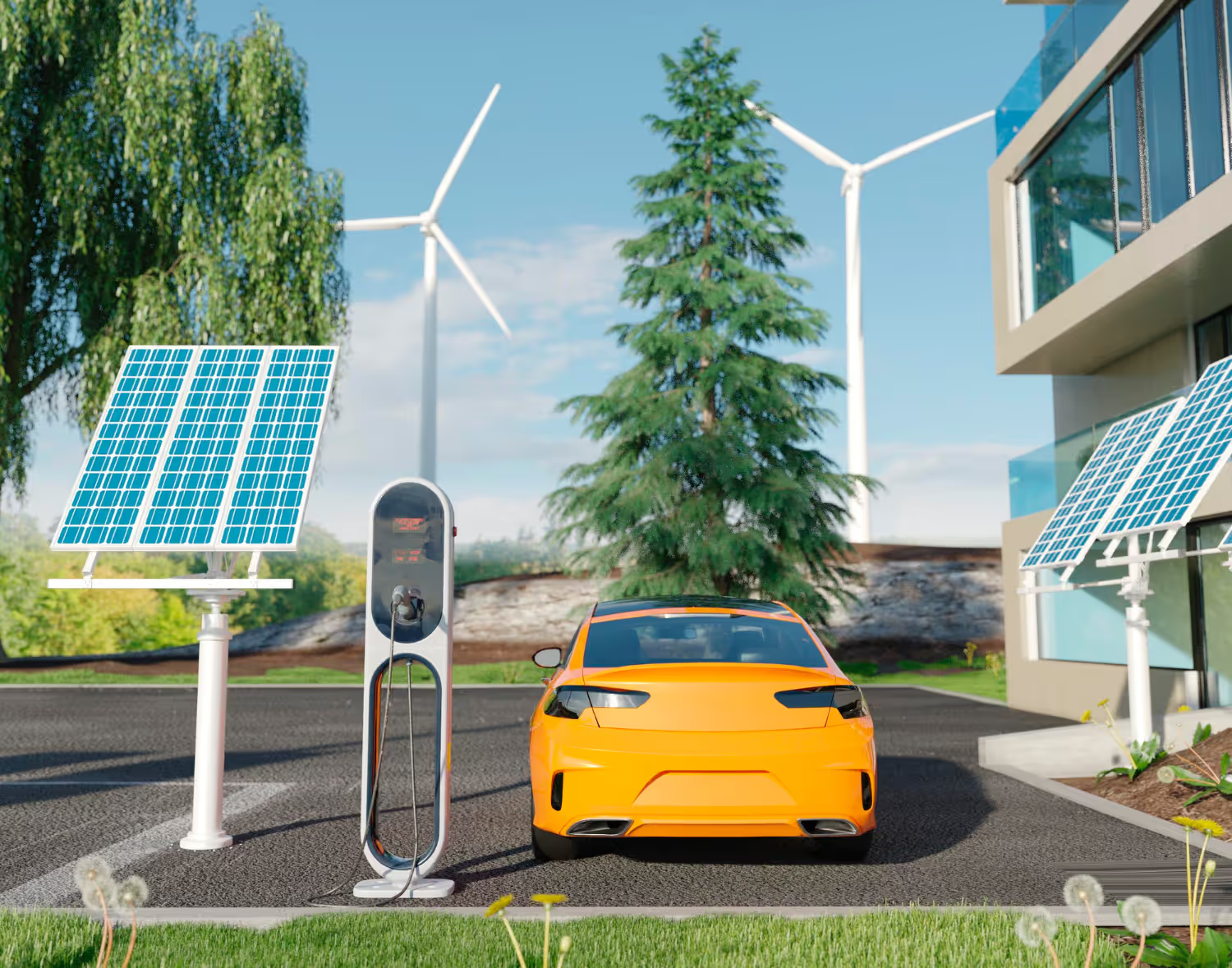
The transformation of EV charging technology from adequate to exceptional centers on charging speed. Early public chargers delivered 50 kilowatts — enough to add perhaps 150 miles of range per hour of charging. Today's ultra-fast charging 350 kW systems represent a sevenfold improvement, fundamentally changing what electric vehicle travel can look like.
How Ultra-Fast Charging Works
Understanding ultra-fast charging requires grasping the electrical engineering involved. Charging speed depends on the power that can flow into a battery, measured in kilowatts. Higher power means faster energy transfer and shorter charging sessions.
Technical foundations of 350+ kW charging:
- High-voltage architecture: Ultra-fast charging requires vehicles with 800-volt (or higher) electrical systems, compared to the 400-volt systems in most current EVs. Higher voltage allows the same power transfer with lower current, reducing heat generation and cable thickness
- Active thermal management: Batteries must remain within optimal temperature ranges during rapid charging. Advanced liquid cooling systems maintain cell temperatures even as power flows at rates that would overheat earlier designs
- Intelligent charge curves: Charging speed varies throughout the session, starting high when the battery is depleted and tapering as it approaches full capacity. Sophisticated battery management systems optimize this curve for speed while protecting battery longevity
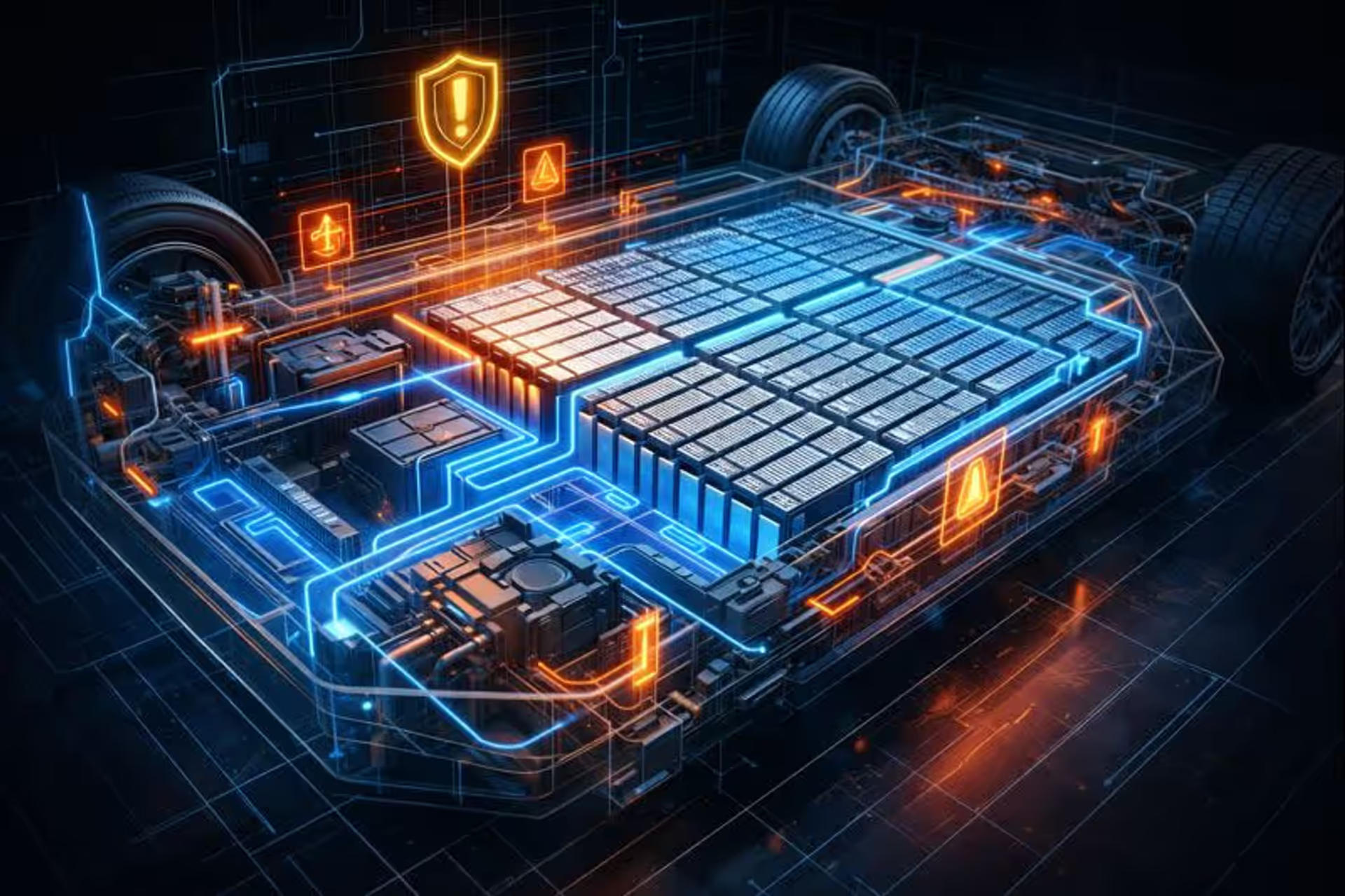
- Grid infrastructure requirements: Delivering 350+ kW to a single vehicle (and often multiple vehicles simultaneously) requires substantial electrical infrastructure — high-voltage feeds, transformers, and sometimes on-site energy storage to buffer demand
The charging experience at these power levels differs dramatically from earlier generations:
| Charging Power | Time to Add 200 Miles | Typical Session Length |
| 50 kW (Level 3 basic) | 60-80 minutes | Coffee and meal |
| 150 kW (current standard) | 25-35 minutes | Coffee break |
| 350 kW (ultra-fast) | 10-15 minutes | Restroom stop |
This speed transformation changes fast charging EV from an inconvenience to be minimized into an experience comparable to gasoline refueling. The psychological barrier of "charging takes forever" dissolves when charging takes barely longer than pumping gasoline and paying inside.
Real-World Impact on Travel and Logistics
Ultra-fast charging's practical implications extend beyond individual convenience to reshape how electric vehicles can be used:
Long-distance travel transformation:
- Road trip feasibility: A 500-mile journey in an EV with 300-mile range and access to 350 kW charging requires one 10-15 minute stop — comparable to gasoline vehicle patterns
- Spontaneous travel: The ability to charge quickly enables unplanned trips without extensive route planning or charging anxiety
- Time-critical journeys: Business travel, family emergencies, and time-sensitive trips become practical in electric vehicles
Commercial and fleet applications:
- Delivery vehicles can recharge during loading/unloading operations, maintaining continuous service
- Ride-share and taxi fleets can charge during driver breaks without significant revenue loss
- Long-haul trucking becomes viable with charging stops comparable to mandatory rest periods
- Rental car operations can turn vehicles between customers quickly
Urban charging models:
- High-turnover urban charging hubs become viable, serving many vehicles daily on limited real estate
- Retail and entertainment destination charging provides meaningful range addition during shopping or dining
- Workplace charging can serve more employees with fewer stations through faster turnover
"Ultra-fast charging doesn't just make EVs more convenient — it makes them viable for use cases that were previously impossible," observes an automotive technology researcher. "The difference between 30-minute and 10-minute charging isn't incremental; it's categorical. It opens entirely new markets and applications."
Infrastructure Challenges and Investment Requirements
Deploying ultra-fast charging at scale presents substantial challenges that explain why buildout has proceeded more slowly than technology would permit:
Grid capacity constraints:
- A single 350 kW charger draws power equivalent to 50-70 average homes
- Multi-stall ultra-fast stations may require dedicated substation connections
- Many locations lack electrical capacity within economically viable upgrade distances
- Utility interconnection timelines can extend to 18-36 months in constrained areas
Economic considerations:
- Ultra-fast charging equipment costs $100,000-$250,000 per stall
- Installation, grid connection, and site work often equal or exceed equipment costs
- Demand charges (fees based on peak power draw) can make ultra-fast stations uneconomic at low utilization
- Return on investment timelines extend 7-15 years under current usage patterns
Technology standardization:
- Multiple charging standards (CCS, NACS, CHAdeMO) fragment the market
- Connector standardization around NACS in North America is progressing but not complete
- Payment systems, network protocols, and user experiences vary across providers
- Interoperability issues create consumer frustration and reduce effective network density
These challenges are being addressed through policy support, utility engagement, and market maturation, but they explain why EV charging in 2026 and beyond will continue reflecting infrastructure buildout timelines rather than immediate technology deployment.
V2G, V2H, and AI: EVs as Part of the Energy System
The most profound transformation in EV charging technology involves reconceiving electric vehicles not as energy consumers but as distributed energy resources. Bidirectional charging — enabling power to flow from vehicles back to grids and homes — and intelligent charging optimization represent the frontier of smart EV charging.
Vehicle-to-Grid (V2G) Explained
Vehicle-to-Grid technology enables electric vehicles to return stored energy to the electrical grid during periods of high demand or low generation. Rather than simply drawing power, V2G-equipped vehicles become mobile power plants, contributing to grid stability and potentially generating revenue for their owners.
Comparison of Bidirectional Charging Technologies:
| Technology | Power Flow | Primary Benefit | Typical Use Case | Revenue Potential |
| V2G (Vehicle-to-Grid) | EV ↔ Grid | Grid stabilization, peak shaving | Utility programs, fleet operations | $50-150/month |
| V2H (Vehicle-to-Home) | EV ↔ Home | Backup power, peak avoidance | Home backup during outages | Savings on peak rates |
| V2L (Vehicle-to-Load) | EV → Devices | Portable power | Camping, job sites, emergencies | Convenience value |
| Smart Charging | Grid → EV (optimized) | Cost reduction, grid-friendly | Daily home/work charging | 20-40% cost savings |
How V2G functions:
- Bidirectional chargers allow power to flow in both directions — into the vehicle during charging, out of the vehicle during discharge
- Communication protocols connect vehicles to grid operators, enabling coordinated dispatch of stored energy
- Aggregation platforms combine many vehicles into virtual power plants, providing grid services at meaningful scale
- Compensation mechanisms reward vehicle owners for making their batteries available to the grid
Grid services V2G can provide:
- Peak demand reduction: Vehicles discharge during afternoon and evening demand peaks, reducing strain on generation and transmission infrastructure
- Frequency regulation: Rapid charge/discharge cycles help maintain the precise 50/60 Hz frequency that grids require
- Renewable integration: Vehicle batteries absorb excess solar generation midday and return it during evening demand, smoothing renewable intermittency
- Emergency backup: During grid outages or extreme events, aggregated vehicle batteries can provide emergency power to critical facilities
The scale potential is staggering. A single electric vehicle with a 75 kWh battery can power an average American home for 2-3 days. A million such vehicles represent 75 gigawatt-hours of distributed storage — more than all utility-scale battery storage currently installed in the United States. At projected 2030 EV populations, vehicle batteries could provide storage capacity exceeding any buildable alternative.
Current V2G deployment status:
- Available on select vehicles from manufacturers including Nissan, Ford, Hyundai, and others
- Pilot programs operating in multiple countries, demonstrating technical feasibility
- Regulatory frameworks for V2G compensation under development in major markets
- Significant expansion expected in EV charging in 2026 and 2027 as standards mature
Vehicle-to-Home (V2H) Benefits
Vehicle to home V2H represents a more immediately practical application of bidirectional charging. Rather than complex grid integration, V2H simply allows an electric vehicle to power a home during outages or periods of high electricity prices.
V2H use cases and benefits:
- Backup power during outages: EV batteries provide days of home power during grid failures, far exceeding typical portable generators
- Peak demand management: Homes can draw from EV batteries during expensive peak rate periods, then recharge overnight at lower rates
- Solar self-consumption optimization: Homes with solar panels can store excess midday generation in EV batteries for evening use, reducing grid dependence
- Emergency preparedness: V2H provides resilience against increasingly frequent extreme weather events and infrastructure failures
Technical implementation of V2H:
- Requires bidirectional-capable vehicle and charger
- Home integration through transfer switch or intelligent panel
- Control systems managing power flow based on grid status, prices, and battery state
- Compatible with both whole-home backup and critical-loads-only configurations
The appeal is straightforward: electric vehicle owners already own substantial battery capacity. V2H simply allows that capacity to serve the home as well as the vehicle. Given increasing grid instability in many regions, the peace of mind provided by a 75-100 kWh home battery that also happens to drive becomes a compelling ownership benefit.
AI Optimization and Smart Grid Integration
AI optimized EV charging represents the intelligence layer that makes V2G, V2H, and basic charging work efficiently. Without sophisticated optimization, charging would occur whenever vehicles connect, creating demand spikes that stress grids and increase costs. With AI optimization, charging becomes a coordinated, predictive, and economically optimized process.
What AI charging optimization does:
- Predicts departure times and energy needs based on historical patterns, calendar events, and user input
- Optimizes charging timing to minimize cost, carbon intensity, and grid impact while ensuring vehicle readiness
- Coordinates across vehicle fleets to prevent simultaneous charging that would create demand spikes
- Integrates with grid signals to shift charging toward periods of abundant renewable generation or away from constrained periods
- Manages V2G/V2H dispatch to maximize value while protecting battery longevity and ensuring vehicle availability
Real-world AI optimization examples:
- Home chargers that automatically charge during lowest-price overnight hours while guaranteeing morning departure readiness
- Fleet systems that sequence vehicle charging to stay within site power limits
- Grid-interactive charging that responds to real-time renewable generation, charging faster when wind or solar output is high
- Predictive systems that pre-condition batteries for optimal charging performance before arriving at fast chargers
"Artificial intelligence in charging isn't a feature — it's a necessity," explains a grid integration researcher. “The alternative is either massive infrastructure overbuilding or chaotic load patterns that destabilize grids. AI is how we make electric transportation work at scale without rebuilding the entire electrical system.”

What This Means for Drivers
The technological developments reshaping EV charging infrastructure translate into tangible changes in the ownership and driving experience. Understanding these implications helps prospective buyers evaluate electric vehicles and current owners anticipate how their experience will evolve.
The Evolving Charging Experience
Improvements drivers will notice in 2026-2027:
- Faster charging sessions: Ultra-fast charging deployment means more locations offering 10-15 minute charging for meaningful range addition
- Better station reliability: Network maturation, improved equipment, and competitive pressure are driving reliability improvements across major networks
- Simplified payment: Industry consolidation around payment standards and plug-and-charge capability eliminates fumbling with apps and cards
- More accurate availability information: Real-time station status, queue lengths, and wait time predictions improve trip planning
- Expanded location options: Charging at retail, entertainment, and workplace destinations becomes more common, integrating charging into existing activities
Remaining friction points:
- Rural and highway gaps: Charging density in less-traveled areas will remain lower than urban areas
- Peak period congestion: Popular routes during holiday travel will experience queuing until capacity catches demand
- Legacy vehicle limitations: Older EVs with 400-volt systems cannot fully utilize 350 kW infrastructure
- Apartment and rental charging: Solutions for residents without dedicated parking continue lagging behind home-owner options
Cost Implications and Economic Considerations
The economics of EV charging are evolving in ways that affect total ownership costs:
Charging cost factors:
- Home charging remains cheapest: Residential electricity rates of $0.10-0.15/kWh translate to fuel costs of 60-70% below gasoline equivalents
- Public charging premiums: DC fast charging typically costs $0.30-0.50/kWh, narrowing but not eliminating the gasoline savings
- Time-of-use optimization: Drivers who can charge during off-peak hours (typically overnight) realize significant savings versus anytime charging
- V2G revenue potential: Early V2G participants report earning $50-150 monthly by making vehicle batteries available for grid services
Total cost of ownership perspective:
- Fuel savings remain substantial even with public charging costs
- Home charging equipment investment ($500-2,000 for Level 2) pays back within 1-2 years for typical drivers
- V2G and V2H capabilities may increasingly offset vehicle depreciation through energy value provision
- Insurance and maintenance savings compound fuel savings for most owners
Practical Considerations for Different Driver Types
EV charging implications vary based on individual circumstances:
For commuters with home charging:
- Daily driving rarely requires public charging
- Overnight Level 2 charging provides full battery each morning
- Home charging costs approximately $0.03-0.05 per mile — roughly 70% below gasoline
- V2H capability provides meaningful backup power value
For apartment dwellers and those without home charging:
- Dependent on public EV charging network for regular charging
- Workplace charging, if available, provides the most convenient and economical solution
- Public charging costs and convenience determine EV viability
- Charging infrastructure buildout is most critical for this population
For frequent long-distance travelers:
- Ultra-fast charging availability along routes determines trip feasibility
- Charging network reliability matters more than for occasional users
- Vehicle choice should emphasize charging speed (800-volt architecture) for frequent road trips
- Subscription programs from charging networks may provide economic benefits
For fleet and commercial operators:
- Charging infrastructure often determines operational viability
- Depot charging overnight supports most delivery and service applications
- Ultra-fast charging enables high-utilization models (taxis, ride-share)
- V2G participation can generate meaningful revenue at fleet scale
What This Means for Energy Providers and Cities
The expansion of EV charging infrastructure creates both challenges and opportunities for utilities, grid operators, and municipal governments. Successfully managing the electric vehicle transition requires these entities to adapt systems, policies, and planning approaches developed for a pre-EV world.
Grid Implications and Utility Adaptation
Challenges utilities face from EV adoption:
- Load growth after decades of flat demand: EV charging represents the first significant new load category for most utilities, reversing efficiency-driven demand reductions
- Distribution system constraints: Local transformers and feeders designed for existing loads may become overloaded as EV penetration increases
- Peak demand amplification: Unmanaged charging concentrated in evening hours when drivers return home coincides with existing residential peaks
- Generation adequacy: Large-scale electrification requires new generation capacity, ideally from clean sources to realize environmental benefits
Utility adaptation strategies:
- Time-of-use rates that incentivize overnight charging through significant price differentials
- Managed charging programs that allow utilities to modulate charging in exchange for rate benefits
- Distribution system investment to upgrade transformers, feeders, and substations in high-adoption areas
- V2G integration to leverage EV batteries as distributed storage resources
- Generation planning that incorporates EV load growth into resource adequacy assessments
According to recent analysis, smart grid technologies including managed charging and V2G could reduce the grid investment required to support mass EV adoption by 40-60% compared to unmanaged scenarios.
Opportunities for utilities:
- New revenue streams from increased electricity sales after decades of flat demand
- Load flexibility from managed charging provides valuable grid services
- Customer engagement through EV programs creates relationships beyond basic commodity service
- Electrification leadership positions utilities as essential partners in decarbonization
Urban Planning and Municipal Considerations
Cities face distinct challenges and opportunities as EV charging stations become essential urban infrastructure:
Municipal planning considerations:
- Curbside charging deployment for residents without off-street parking
- Zoning and building codes requiring charging readiness in new construction
- Permitting streamlining to accelerate private charging installation
- Public charging location strategy ensuring equitable access across neighborhoods
- Parking policy adaptation to accommodate charging time limits and turnover requirements
Equity and access concerns:
- Income disparities in home charging access: Higher-income residents more likely to have garages and home charging capability
- Neighborhood charging deserts: Lower-income areas may receive less private charging investment
- Rental housing charging gaps: Tenants dependent on landlord willingness to invest in charging
- Older building electrical constraints: Retrofitting charging in older multi-family buildings often prohibitively expensive
Strategies for equitable charging access:
- Public investment in underserved areas where private investment is insufficient
- Requirements for charging in affordable housing development
- Incentives for landlords to install tenant-accessible charging
- Curbside charging prioritization in neighborhoods with limited off-street parking
- Community charging hubs serving residents without home options
The Urban Infrastructure Opportunity
Forward-thinking cities recognize EV charging infrastructure as an opportunity rather than merely a challenge:
Economic development benefits:
- Charging hub locations become destination points, supporting adjacent retail and services
- EV-related employment in installation, maintenance, and operations
- Attraction of EV-oriented residents and businesses to well-served areas
- Reduced fuel imports as electricity replaces petroleum
Environmental and quality-of-life improvements:
- Reduced local air pollution from displaced gasoline and diesel combustion
- Decreased noise pollution from electric vehicle operation
- Climate benefits from transportation electrification (when powered by clean electricity)
- Reduced urban heat island effects from decreased waste heat
Resilience and energy security:
- V2G-capable EV fleets provide distributed emergency power capacity
- Reduced dependence on volatile global petroleum markets
- Local electricity generation can power local transportation
- Distributed storage enhances grid stability during extreme events
EV Charging in 2026–2027: What Will Actually Change
Projecting infrastructure development requires synthesizing current investment trajectories, technology readiness, and policy momentum. The coming two years will see significant progress, though gaps will remain.
Infrastructure Expansion Projections
Quantitative expectations for 2026-2027:
- Public charging point growth: Global public chargers expected to approximately double from current levels, reaching 5-6 million points
- Ultra-fast charging share: 350+ kW chargers expanding from approximately 5% to 15-20% of DC fast charging capacity
- Highway corridor completion: Major inter-city routes in developed markets achieving 50-mile or better ultra-fast spacing
- Urban charging density: Metropolitan areas in leading markets approaching 10-15 public chargers per 1,000 EVs
Key geographic variations:
- China: Already leads in charging deployment; will extend lead through state-coordinated investment
- Europe: EU mandates driving corridor build-out; urban charging varying by national policy
- United States: Federal investment (NEVI program) funding significant expansion; private investment concentrating in high-value corridors
- Emerging markets: Charging infrastructure remaining a significant constraint on adoption
Technology Maturation Timelines
Technologies reaching mainstream deployment in 2026-2027:
- Plug-and-charge capability: Automatic authentication and payment upon connection becoming standard across networks
- Megawatt charging for trucks: Heavy-duty charging standards enabling long-haul trucking electrification
- Improved reliability and uptime: Network operators achieving 95%+ uptime targets through better equipment and maintenance
- Real-time availability integration: Navigation systems accurately reflecting charger status, queue lengths, and predicted wait times
Technologies in early deployment or pilot phase:
- V2G at scale: Commercial programs operating but not yet achieving significant grid impact
- AI-optimized network management: Deployed by leading operators; not yet universal
- Wireless charging: Available for some vehicles; not yet cost-competitive for mainstream deployment
- Battery swapping: Operating in specific markets (notably China) but not expanding broadly
Remaining Gaps and Challenges
Issues likely to persist beyond 2027:
- Rural and remote area coverage: Low utilization rates make commercial deployment uneconomic without subsidy
- Multi-family housing solutions: No scalable solution for the 30%+ of households without dedicated parking
- Grid capacity constraints: Utility upgrade timelines will continue limiting deployment speed in some locations
- Charging equity: Lower-income areas and communities will likely remain underserved relative to affluent areas
- International standardization: Different standards across regions will continue complicating global vehicle platforms
Factors that could accelerate or delay progress:
| Acceleration Factors | Delay Factors |
| Stronger policy mandates | Economic recession reducing investment |
| Faster utility interconnection | Supply chain disruptions for equipment |
| Technology cost reductions | Regulatory or permitting obstacles |
| Increased private investment | Grid infrastructure limitations |
| Rapid V2G standards adoption | Consumer adoption slower than projected |
The Economics of EV Charging Networks
Understanding the business models underlying EV charging network development illuminates why infrastructure has lagged and what conditions would accelerate deployment.
Current Business Model Challenges
Why charging networks struggle with profitability:
- Low utilization rates: Many stations see only 2-4 charging sessions daily, far below the 15-20+ needed for profitability
- High capital costs: Equipment, installation, and grid connection require substantial upfront investment
- Demand charges: Utility rate structures penalizing peak demand make ultra-fast charging uneconomic in many jurisdictions
- Competitive pressure: Multiple networks competing for limited EV population prevents pricing power
- Technology obsolescence risk: Rapid capability improvements create uncertainty about equipment useful life
Current revenue model limitations:
- Per-kWh charging fees alone rarely cover costs at current utilization
- Subscription models require scale to generate meaningful revenue
- Advertising and retail partnerships provide marginal supplemental income
- Grid services revenue not yet significant for most operators
Emerging Economic Models
Approaches that may improve charging network economics:
- Real estate integration: Charging as amenity that drives traffic to retail, hospitality, and service locations
- Fleet contracts: Guaranteed utilization from commercial fleets providing revenue certainty
- Utility rate structures: Time-of-use and demand charge reforms improving station economics
- V2G services: Grid service revenue providing additional income stream
- Advertising and data: Location-based advertising and charging behavior data monetization
- Bundled services: Charging combined with vehicle services, insurance, or energy products
Investment and subsidy sources:
- Government programs (NEVI in US, various European programs) providing capital support
- Oil company investment as hedge against core business decline
- Utility investment as load development strategy
- Automaker investment to support vehicle sales
- Private equity and infrastructure funds seeking long-term returns
Path to Sustainable Operations
The EV charging infrastructure sector is transitioning from growth-focused to sustainability-focused business models:
Factors supporting eventual profitability:
- Rising EV populations increasing charger utilization
- Declining equipment costs improving capital efficiency
- Operational learnings reducing maintenance expenses
- Rate structure reforms improving station economics
- V2G revenue providing supplemental income
- Premium locations commanding pricing power
The industry consensus suggests that leading networks will achieve profitability as EV penetration reaches 15-20% of vehicle populations, expected in major markets between 2027 and 2030. Until then, infrastructure deployment will continue depending on subsidy support, strategic investment, and long-term positioning bets.
Global Perspectives on Charging Development
The future of EV charging varies dramatically across regions, reflecting different policy environments, market structures, and development approaches.
Global EV Charging Infrastructure Comparison (2025):
| Region | Public Chargers | DC Fast Share | Avg Spacing (Highways) | V2G Status | Key Driver |
| China | ~2.0 million | 80%+ | 30-50 km | Pilots active | State coordination |
| Europe | ~600,000 | 15-20% | 60-100 km | Regulatory framework ready | EU mandates (AFIR) |
| United States | ~180,000 | 20-25% | 50-100 km | Early pilots | Federal investment (NEVI) |
| Japan | ~30,000 | 35% | Variable | Advanced trials | Utility partnerships |
| South Korea | ~25,000 | 40% | 40-60 km | Commercial programs | Government targets |
China: State-Coordinated Dominance
China leads global charging deployment through coordinated state planning and execution:
Key characteristics:
- More public charging points than rest of world combined
- State-owned enterprises dominating network operation
- Aggressive DC fast charging deployment (80%+ of public points)
- Battery swapping operating at scale for taxis and commercial vehicles
- V2G pilots progressing toward commercial deployment
Lessons and limitations:
- State coordination enables rapid deployment impossible in market-driven systems
- Quality and reliability concerns in rapid build-out
- Standards potentially diverging from global norms
- Model difficult to replicate in other governance contexts
Europe: Regulatory-Driven Expansion
European Union mandates are driving infrastructure development across member states:
Key developments:
- Alternative Fuels Infrastructure Regulation (AFIR) requiring charging stations every 60 km on major corridors
- National targets and incentives supplementing EU requirements
- Strong ultra-fast charging deployment, particularly in Northern Europe
- Active V2G pilot programs and regulatory frameworks
Challenges:
- Uneven deployment across member states
- Grid constraints limiting deployment speed in some regions
- Payment and roaming interoperability issues across networks
- Rural area coverage lagging urban centers
United States: Market Plus Policy
American infrastructure development combines private investment with federal and state support:
Current landscape:
- NEVI program providing $7.5 billion for charging deployment
- Private networks (Tesla, Electrify America, ChargePoint, EVgo) competing for position
- Tesla Supercharger network opening to non-Tesla vehicles
- State-level programs supplementing federal investment
Distinctive features:
- Fragmented network landscape with multiple competing providers
- Higher proportion of home charging relative to public infrastructure
- Significant regional variation in deployment density
- Ongoing standards consolidation around NACS connector
Conclusion: Infrastructure as Destiny
The electric vehicle transition has reached an inflection point where infrastructure, not vehicles, determines the pace of adoption. The cars are ready. The batteries are capable. The performance is compelling. The economics are increasingly favorable. What remains underdeveloped is the ecosystem that makes electric vehicles practical for the full range of uses that drivers expect.
This reality demands a shift in how we think about electric mobility. The vehicle remains important, but it is increasingly a solved problem. The remaining challenges center on EV charging infrastructure — its density, speed, reliability, intelligence, and accessibility. Until these challenges are adequately addressed, mass adoption will proceed more slowly than vehicle capabilities and environmental imperatives would suggest.
The key developments shaping the charging future:
- Ultra-fast charging is transforming the road trip experience, making electric vehicles viable for any journey that gasoline vehicles can accomplish
- Vehicle-to-Grid and Vehicle-to-Home technologies are reconceiving electric vehicles as energy assets, not merely transportation appliances
- AI-powered optimization is making the complex coordination of millions of vehicles and the electrical grid manageable at scale
- Investment and deployment are accelerating, driven by policy support, competitive pressure, and improving economics
For drivers, the implications are increasingly positive. The charging experience is improving along every dimension — speed, reliability, availability, and cost predictability. The vision of electric vehicles as seamlessly practical transportation is becoming reality, though progress remains uneven across geographies and use cases.
For energy systems, electric vehicles represent both challenge and opportunity. The load growth is significant, but so is the distributed storage capacity that vehicle batteries represent. With intelligent management, the electric vehicle fleet becomes a grid asset rather than merely a grid burden.
For cities and societies, charging infrastructure development offers an opportunity to reshape urban form, improve air quality, enhance resilience, and advance equity — if deployed thoughtfully. The choices made now about where and how to build EV charging stations will echo through decades of transportation patterns.
"In the end, the transition to electric mobility is not primarily a vehicle story — it is an infrastructure story," concludes a transportation policy expert. "We have the vehicles we need. Now we must build the ecosystem that makes them work. That is the task that will define whether electrification succeeds in the timeframe that climate change demands."
The future of EV charging is not merely a prediction but a project. It requires sustained investment, thoughtful policy, technological innovation, and coordinated execution. The foundations are being laid now. The next few years — EV charging in 2026 and beyond — will determine whether those foundations prove adequate to support the mass electric vehicle adoption that environmental necessity demands and technological capability permits.
The vehicles are ready. The question is whether we will build the infrastructure to match them.
Related Stories
Read more