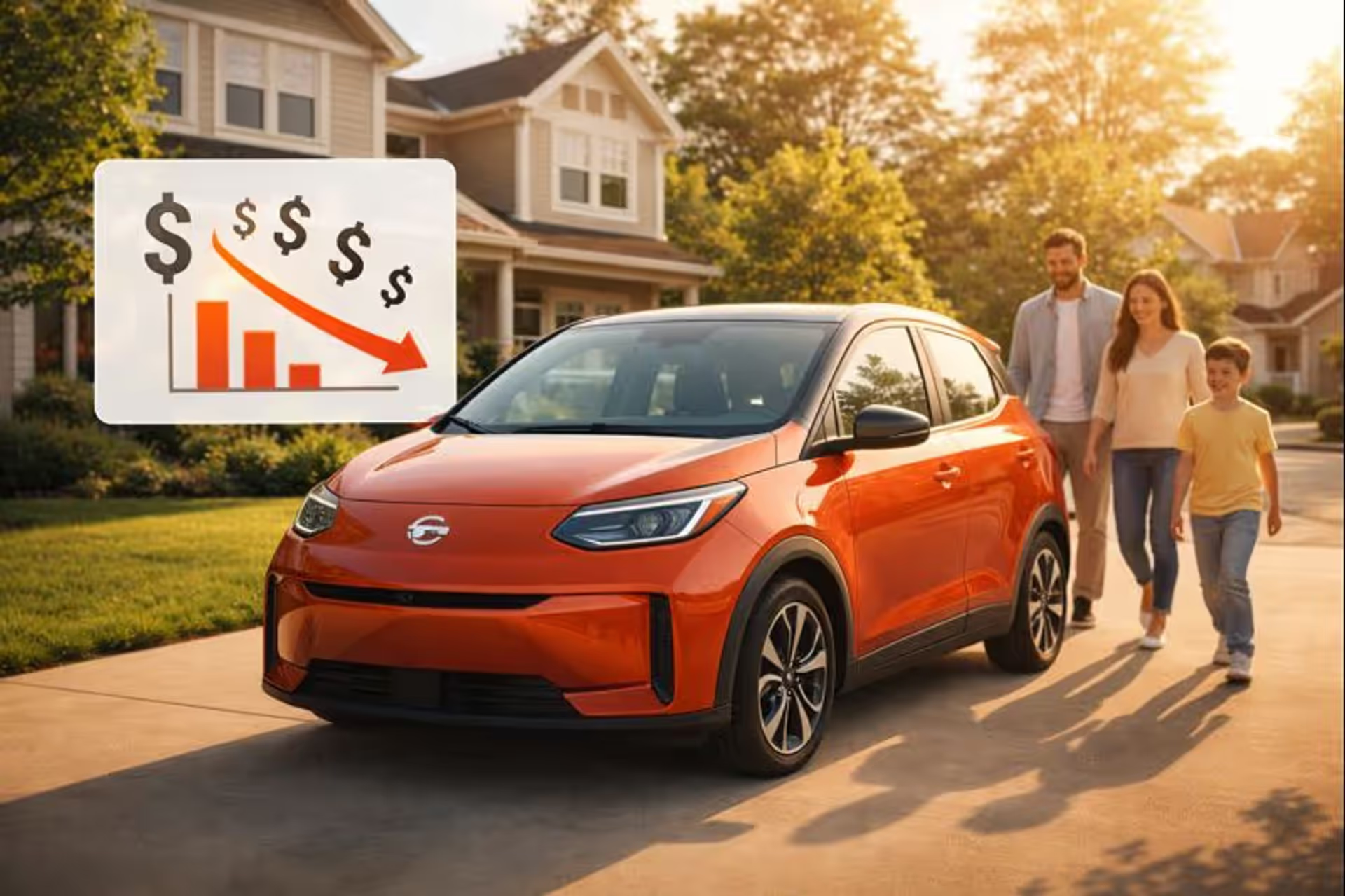
The price barrier is falling.
The Race to Affordable Electric Cars: How Cost Reduction Is Opening EVs to the Mass Market

Introduction: The Final Barrier to Mass Adoption
The electric vehicle revolution has proven its technological case. Modern EVs offer superior driving dynamics, lower operating costs, zero tailpipe emissions, and increasingly competitive range. The early adopter objections — that electric cars couldn't match gasoline vehicles for performance, practicality, or reliability — have been systematically dismantled by a decade of engineering progress. Yet one barrier remains stubbornly intact: price.
The average new electric vehicle in the United States still sells for over $55,000 — roughly $10,000 more than the average new car and far beyond what most households can afford. While premium EVs have proven the technology's appeal to affluent buyers, the mass market that will ultimately determine the electric transition's success requires affordable electric cars that compete directly with the mainstream gasoline vehicles most people actually buy. The promise of electrification means little to a family shopping for a $25,000 commuter car if every EV on the lot costs twice that.
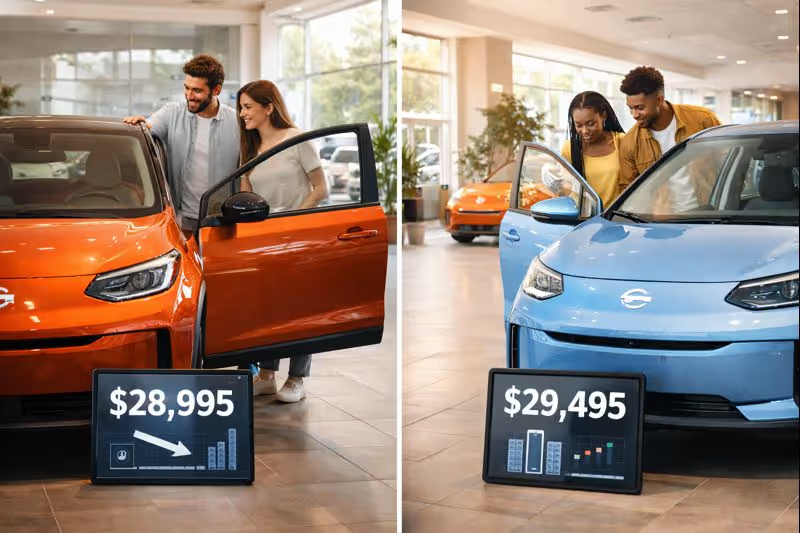
This affordability challenge has become the automotive industry's defining mission. Manufacturers across the globe are racing to deliver budget electric vehicles that can reach price points previously considered impossible. The target crystallizing across the industry centers on electric cars under 30000 dollars — and increasingly, electric cars under 25000 — where the mass market actually shops. Achieving these prices while maintaining acceptable range, quality, and profitability requires reinventing nearly every aspect of how electric vehicles are designed, manufactured, and sold.
The historical context matters. Automobiles themselves were once luxury items accessible only to the wealthy — until Henry Ford's manufacturing innovations made the Model T affordable for middle-class families, transforming transportation and society. The electric vehicle industry faces a similar transformation moment. The technology works; the question is whether it can be made affordable enough, fast enough, to achieve the universal adoption that both market opportunity and climate necessity demand.
The stakes extend beyond individual manufacturers' market share. The question of when will EVs be cheaper than gas cars carries implications for climate policy, energy security, and the automotive industry's very structure. A future where affordable EVs routinely undercut gasoline alternatives would transform personal transportation far more rapidly than any government mandate or incentive program. Conversely, persistent price premiums would relegate electric vehicles to a substantial but ultimately limited market segment, slowing the transition and extending petroleum's transportation dominance.
The economic forces driving this transformation operate at multiple levels simultaneously. Battery costs continue their decade-long decline as manufacturing scales and chemistry improves. Manufacturing processes mature as automakers accumulate EV-specific production experience. Competition intensifies as more manufacturers pursue the same mass-market opportunity. Policy support — from purchase incentives to charging infrastructure investment — creates conditions where affordable EVs can succeed. Each force reinforces the others, creating momentum toward affordability that individual setbacks cannot fully arrest.
"The technology battle is largely won — electric powertrains are simply better in most ways that matter to consumers," observes an automotive industry economist. "The remaining battle is economic, and whoever wins the race to affordable EVs will reshape the global auto industry."
This analysis examines the forces driving electric vehicle cost decline, the strategies manufacturers are pursuing to reach mass-market price points, and which contenders are best positioned to deliver the mass market electric vehicles that will define the next phase of automotive electrification. Understanding these dynamics illuminates not just where EV prices are heading, but why the timeline matters so profoundly.
Why Electric Vehicles Still Cost More
Understanding the path to affordable EVs 2026 and beyond requires first understanding why electric vehicles currently command price premiums over comparable gasoline alternatives. The cost structure of EVs differs fundamentally from internal combustion vehicles in ways that both explain current premiums and suggest pathways for reduction.
The Battery Cost Challenge
The battery pack remains the single largest cost component in any electric vehicle, typically representing 30-40% of total vehicle cost. This concentration of value in one component creates both the problem and the opportunity: reduce battery costs, and vehicle prices follow proportionally. The history of EV battery cost per kWh decline provides the foundation for understanding future affordability.
Battery pack costs have fallen dramatically over the past decade — from over $1,100 per kilowatt-hour in 2010 to approximately $140-150 per kWh in 2024. This lithium ion battery cost reduction of nearly 90% represents one of the most rapid cost declines for any major technology component in industrial history. The decline reflects manufacturing scale, production learning, chemistry improvements, and supply chain maturation working in combination.
Yet even at current prices, batteries add substantial cost that gasoline vehicles simply don't bear. A 60 kWh battery pack — sufficient for approximately 250 miles of range in an efficient vehicle — costs roughly $8,000-9,000 at current prices. This component alone exceeds the entire powertrain cost of many economy gasoline vehicles. The mathematical reality means that achieving genuine price parity requires either further battery cost reduction, smaller battery packs, or accepting lower margins than gasoline competitors.
The trajectory of battery price trends electric vehicles suggests continued decline, with projections placing pack costs at $100 per kWh by 2026-2027 and potentially $80 per kWh by 2030. These projections assume continued scale increase, manufacturing improvements, and chemistry evolution — assumptions that historical trends support but that face headwinds from raw material costs and supply constraints. The battery cost reduction EV pathway remains the single most important factor determining when cheap electric cars become genuinely competitive.
Manufacturing Scale and Learning
Beyond batteries, EV manufacturing costs reflect the industry's relative immaturity compared to a century of internal combustion vehicle production optimization. The EV manufacturing costs that elevate prices include factors that scale and experience will address, but not instantaneously.
Gasoline vehicle production benefits from manufacturing processes refined across billions of units produced. Every aspect of ICE vehicle assembly — from stamping to welding to paint to final assembly — has been optimized through decades of continuous improvement. Electric vehicle production, while leveraging much common automotive manufacturing knowledge, involves distinct processes for battery pack assembly, electric motor production, and power electronics integration that haven't yet accumulated equivalent optimization.
The EV economies of scale that reduce per-unit costs require production volumes that most EV programs haven't yet achieved. A gasoline platform producing 500,000 vehicles annually spreads tooling, engineering, and overhead costs across a large denominator; an EV platform producing 50,000 units annually bears ten times the per-unit burden. As EV production scales — Tesla now produces over 1.8 million vehicles annually; BYD exceeds 3 million — these scale economics increasingly favor electric vehicles.
The learning curve effects visible in Tesla's cost trajectory illustrate the potential. Tesla's production cost per vehicle has declined significantly as volume increased, not because of any single breakthrough but through the accumulation of thousands of small improvements across design, manufacturing, and supply chain. This electric vehicle production costsreduction through learning applies across the industry as manufacturers gain EV-specific experience.
The EV vs Gasoline Cost Equation
The comparison between electric cars vs gas cars cost involves more complexity than sticker prices alone capture. Total cost of ownership — incorporating purchase price, fuel, maintenance, and depreciation — tells a different story than showroom prices suggest. Understanding this complete picture illuminates why EV adoption can proceed even before purchase price parity is achieved.
Total Cost of Ownership Analysis
The EV total cost of ownership calculation increasingly favors electric vehicles despite higher purchase prices. Fuel cost savings accumulate significantly over typical ownership periods. At national average electricity rates (approximately $0.15 per kWh) and gasoline prices (approximately $3.50 per gallon), an EV consuming 30 kWh per 100 miles costs roughly $4.50 to travel that distance, while a gasoline vehicle achieving 30 MPG costs approximately $11.67 — a fuel cost advantage of over 60% for the EV.
Maintenance cost differences compound fuel savings. Electric vehicles eliminate oil changes, transmission service, exhaust system maintenance, and many other routine costs that gasoline vehicles require. Brake wear decreases substantially because regenerative braking handles most deceleration. The long term cost electric vehicles advantage in maintenance typically runs $1,000-2,000 over a typical ownership period, though this varies with driving patterns and vehicle specifics.
The electric car savings over time from fuel and maintenance can offset substantial purchase price premiums. A buyer keeping a vehicle for 100,000 miles might save $6,000-8,000 in fuel costs alone compared to an equivalent gasoline vehicle. Adding maintenance savings, the total ownership cost advantage can approach or exceed $10,000 over the vehicle's life — enough to offset significant purchase price differences.
Insurance costs and depreciation complicate the comparison. EV insurance rates often exceed those for comparable gasoline vehicles, reflecting higher repair costs and insurer uncertainty about battery longevity. Depreciation patterns for EVs remain less predictable than for established gasoline models, creating resale value uncertainty that affects total ownership calculations. These factors narrow the total cost advantage that fuel and maintenance savings create.
When Price Parity Arrives
The question of when will EVs be cheaper than gas cars depends on whether the comparison addresses purchase price, total cost of ownership, or some hybrid measure. By total cost measures, parity has already arrived for many use cases — high-mileage drivers, those with low electricity rates, and buyers who keep vehicles for extended periods often find EVs economically advantageous today.
Purchase price parity — the point where comparable EVs and gasoline vehicles carry similar sticker prices — requires further cost reduction that current trajectories suggest will arrive in the 2026-2028 timeframe for some segments. The compact and subcompact segments where entry level electric cars compete may reach parity first, because smaller battery requirements make the absolute battery cost more manageable. Larger vehicles requiring larger packs face longer timelines to purchase price parity.
Table 1: EV vs ICE Cost Comparison (Compact Segment, 2024 vs 2027 Projection)
| Cost Factor | ICE Vehicle 2024 | EV 2024 | EV 2027 (Projected) |
| Purchase Price | $26,000 | $35,000 | $27,000-29,000 |
| Fuel Cost (5 years, 60k miles) | $7,000 | $2,700 | $2,700 |
| Maintenance (5 years) | $3,500 | $1,500 | $1,500 |
| Insurance (5 years) | $6,000 | $7,500 | $6,500 |
| Total 5-Year Cost | $42,500 | $46,700 | $37,700-39,700 |
| Cost per Mile | $0.71 | $0.78 | $0.63-0.66 |

The Price War Reshaping the Market
The EV price war that erupted in 2023 and continues through 2024-2025 has accelerated the timeline for affordable EVs while creating both opportunities and casualties. Understanding this competitive dynamic illuminates how electric vehicle price competition is reshaping manufacturer strategies and consumer expectations.
How the Price War Started
Tesla's decision to slash prices across its lineup in early 2023 triggered competitive responses that continue reverberating through the industry. The price cuts — reaching 20% or more on some models — forced competitors to respond or watch market share erode. The resulting EV market pricing trends saw prices decline across brands and segments in ways that compressed the timeline toward affordability.
The strategic logic behind Tesla's move combined multiple factors. Production scale at Tesla's newer factories enabled lower per-unit costs, creating room for price reduction while maintaining margins. The Inflation Reduction Act's restructured tax credits threatened to disadvantage Tesla vehicles that didn't meet domestic content requirements, making pre-credit price competitiveness more important. Demand softness as early adopter enthusiasm waned and mainstream buyers remained price-sensitive suggested that volume growth required price accessibility.
The competitive response revealed different manufacturer positions. Chinese brands, particularly BYD, could match or undercut Tesla's prices because their cost structures enabled profitability at lower price points. Traditional automakers faced harder choices — matching prices often meant selling EVs at losses that their business models couldn't sustain at scale. The electric car pricing strategy variation across manufacturers reflected their different cost positions, production scales, and strategic priorities.
Impact on Market Dynamics
The price war has produced winners, losers, and transformed expectations. Chinese manufacturers have strengthened their competitive position, demonstrating cost leadership that traditional Western and Japanese automakers struggle to match. Tesla has maintained volume growth while sacrificing margin — a trade-off that proved sustainable given the company's cost structure but that others cannot easily replicate.
Traditional automakers have responded with varying success. Some have launched competitive products at aggressive prices, accepting near-term losses for market position. Others have retreated from volume EV ambitions, focusing on premium segments where price competition is less intense. Still others have delayed EV programs while cost structures remain uncompetitive, hoping that battery cost reduction EV trajectories will improve economics before they must compete directly.
Consumer expectations have shifted significantly. The price reductions have established new reference points for what EVs "should" cost, making prices that seemed competitive before the war appear overpriced now. This expectation shift affects every manufacturer's positioning and creates pressure for continued reduction even as input costs challenge margins.
Strategies for Cost Reduction
Achieving affordable electric cars at scale requires coordinated cost reduction across multiple dimensions. Manufacturers are pursuing varied strategies reflecting their different starting positions, capabilities, and market targets. The EV manufacturing cost reduction approaches gaining traction share common themes while differing in execution.
Battery Strategy Evolution
The largest opportunity for electric vehicle cost decline lies in battery costs, driving intensive focus on chemistry, sourcing, and manufacturing approaches that can accelerate cost reduction beyond baseline projections.
Lithium iron phosphate (LFP) chemistry has gained substantial share despite lower energy density than nickel-based alternatives, because its lower cost per kWh enables cheaper vehicles even with somewhat larger packs. Tesla, BYD, and others have shifted standard-range models to LFP, accepting modest range penalties for meaningful cost reduction. The cheaper EV batteries enabled by LFP prove particularly valuable for budget electric vehicles where range requirements are moderate and price sensitivity is high.
Cell-to-pack and cell-to-body architectures eliminate intermediate structural elements, reducing both material cost and manufacturing complexity. Rather than building cells into modules and modules into packs, these approaches integrate cells directly into larger structures — sometimes into the vehicle body itself. BYD's Blade Battery and Tesla's structural pack exemplify this trend, achieving cost and weight reduction simultaneously.
Solid state battery cost projections suggest transformative potential, but commercial availability remains years away. When solid-state technology matures, its higher energy density could enable smaller, cheaper packs providing equivalent range — potentially the breakthrough that achieves definitive purchase price parity. However, manufacturing challenges have repeatedly delayed projected timelines, making reliance on solid-state for near-term affordability unwise.
Platform and Manufacturing Innovation
Beyond batteries, the EV platform cost efficiency strategies manufacturers are pursuing target the fundamental economics of vehicle development and production.
Dedicated EV platforms designed from inception for electric powertrains achieve efficiencies that adapted gasoline platforms cannot match. The packaging advantages of electric drive — motors and batteries rather than engines and transmissions — enable interior space utilization and structural efficiency that purpose-built platforms exploit. While platform development requires substantial investment, the amortization across high volumes can reduce per-vehicle costs below what conversion strategies achieve.
Manufacturing process innovation targets both cost and quality. Tesla's "unboxed" manufacturing approach — building major vehicle sections independently before final assembly rather than traditional sequential construction — promises significant floor space and capital reduction. Gigacasting — using massive die-casting machines to produce large structural components in single pieces — reduces part count, welding operations, and assembly complexity. These innovations, while requiring substantial capital investment, enable low cost EV manufacturing that conventional approaches cannot match.
EV supply chain optimization addresses costs beyond the factory. Vertical integration — controlling battery cell production, motor manufacturing, and other key components — enables cost optimization across boundaries that arm's-length supplier relationships cannot achieve. Geographic supply chain concentration reduces logistics costs and improves coordination. The battery supply chain EV strategies manufacturers are pursuing determine not just costs but also supply security and flexibility.
Contenders for the People's EV
The race to deliver mass market EV models competitive with mainstream gasoline vehicles has attracted varied contenders with different strengths and strategies. Understanding who is positioned to deliver upcoming affordable electric cars illuminates where the accessible EV future will likely emerge.
Chinese Manufacturers: Cost Leadership
Chinese automakers have established cost positions that Western competitors struggle to match, making them formidable contenders for the popular electric cars 2026 market. BYD, in particular, has demonstrated ability to deliver capable EVs at price points others cannot profitably achieve.
BYD's Seagull, selling in China for approximately $10,000, represents the extreme of current affordability — a city-focused EV with adequate range for urban use at prices below most gasoline subcompacts. While regulatory and trade barriers currently prevent direct U.S. and European sales at these prices, the underlying capability exists. The BYD Dolphin, available in some markets at $20,000-25,000, offers a more globally relevant template for accessible EVs.
The Chinese cost advantage reflects multiple factors working in combination. Vertical integration through battery production (BYD manufactures its own cells) eliminates supplier margins. Manufacturing scale spreads costs across enormous volumes. Labor cost advantages, while narrowing, remain significant. Government support — from subsidies to infrastructure to regulatory favor — reduces costs that manufacturers in other regions must bear. The EV manufacturing costs Chinese producers face differ fundamentally from those Western manufacturers confront.
The trade barrier question determines how directly Chinese cost leadership translates to Western markets. Tariffs effectively exclude Chinese EVs from the U.S. market; European anti-subsidy investigations may result in duties that narrow price advantages. However, Chinese manufacturers are establishing production in Europe and other markets, potentially circumventing trade barriers while retaining cost advantages from supply chain relationships and manufacturing expertise.
Tesla: Scale and Innovation
Tesla's position as the world's largest pure-play EV manufacturer provides scale advantages that support aggressive pricing, while its innovation culture generates manufacturing efficiencies that competitors struggle to replicate. The promised "next-generation vehicle" — targeting a roughly $25,000 price point — represents Tesla's bid to dominate the entry level electric cars segment.
Tesla's cost structure has improved continuously as production scaled and manufacturing techniques matured. The company reports automotive gross margins that, while compressed by price cuts, remain positive — suggesting ability to profitably deliver vehicles at prices that force competitors to choose between market share and profitability. The Model 3, already among the more affordable EVs in its segment, could be joined by genuinely cheap electric cars if announced plans materialize.
The "next-generation" vehicle Tesla has discussed would represent a significant step toward true mass-market affordability. Details remain limited, but indications suggest a smaller vehicle than current offerings, manufactured using advanced techniques including extensive gigacasting, and priced to compete directly with mainstream gasoline compacts. If delivered as described, this vehicle could represent the best affordable EVs available from any Western manufacturer.
Traditional Automakers: Catching Up
Traditional automakers face the challenge of achieving EV cost competitiveness while managing the transition from profitable gasoline businesses. The strategies vary, but several contenders are positioning for the affordable EVs 2026market.
Volkswagen's ID.2all concept previews a small EV targeting approximately €25,000 in Europe — roughly $27,000-28,000 — with production expected in 2025-2026. The vehicle would leverage VW's MEB platform economies and European production to deliver accessible pricing. Volkswagen's scale and manufacturing expertise provide foundations for competitive cost, though the company has struggled to achieve profitability on current EV offerings.
General Motors has announced intentions to deliver EVs at lower price points using its Ultium platform, with the Chevrolet Equinox EV already reaching sub-$35,000 pricing. Further reduction toward electric cars under 30000territory appears planned, leveraging GM's manufacturing scale and battery joint venture economics. The trajectory suggests GM takes the affordable EV market seriously, though execution has sometimes lagged announcements.
Hyundai-Kia's EV portfolio demonstrates competitive capability, with pricing that approaches accessibility in some markets. The upcoming smaller EVs on dedicated platforms could reach price points that make electric cars for first time buyers genuinely attractive from Korean manufacturers. The group's manufacturing quality and brand positioning support premium pricing, but mass-market ambitions require reaching lower price points.
"The affordable EV market will ultimately be won by whoever can profitably deliver acceptable vehicles at prices mainstream buyers will pay," notes an automotive market analyst. "Right now, that's primarily Chinese manufacturers and Tesla. Traditional automakers need to demonstrate they can compete before time runs out."
The 2026 Market Outlook
The EV market forecast 2026 suggests a pivotal period when multiple affordable EV launches converge with continued cost reduction to potentially transform the accessible EV landscape. Understanding what this market might look like helps contextualize the transformation underway.
Expected Product Launches
The electric car prices 2026 environment will include numerous new entries targeting mass-market price points:
Table 2: Expected Affordable EV Launches 2025-2027
| Manufacturer | Model | Target Price (USD) | Expected Range | Target Market | Timeline |
| Tesla | Next-gen compact | ~$25,000 | 250+ miles | Global | 2025-2026 |
| Volkswagen | ID.2 | ~$27,000 | 280+ miles | Europe, then global | 2025-2026 |
| BYD | Various | $15,000-25,000 | 200-300 miles | China, expanding | Available now |
| GM/Chevrolet | Sub-Equinox EV | ~$30,000 | 250+ miles | North America | 2026 |
| Hyundai | Entry EV | ~$28,000 | 250+ miles | Global | 2026-2027 |
| Stellantis | Citroën ë-C3 | ~$25,000 | 200 miles | Europe initially | 2024-2025 |
| Renault | R5 E-Tech | ~$27,000 | 250 miles | Europe | 2024-2025 |
This wave of launches represents the industry's collective bet that the future of affordable electric cars arrives in the mid-2020s. The clustering of launches reflects both competitive pressure and the maturation of platforms and battery economics that enable affordable pricing.
Market Transformation Potential
The EV adoption trends 2026 could accelerate dramatically if affordable launches succeed. Current EV adoption remains concentrated among higher-income households; accessible pricing would open the market to middle-income buyers who represent the majority of vehicle purchasers. This democratization of EV access could produce adoption curves far steeper than current trajectories suggest.
The electric vehicle market growth implications extend beyond unit sales to market share dynamics. In segments where affordable EVs compete directly with gasoline alternatives, market share could shift rapidly once price barriers fall. The compact and subcompact segments — where mainstream buyers shop and where affordable EV launches concentrate — could see EV market share reach 20-30% by 2027 in supportive markets, up from single digits today.
The sustainability of this growth depends on whether manufacturers can achieve profitability at accessible prices. Launches that generate losses with each sale cannot persist indefinitely; sustainable growth requires business models where affordable EVs contribute to rather than drain manufacturer finances. The EV market pricing trends through 2026 and beyond will reveal whether current cost trajectories enable profitable affordable EVs or whether manufacturers must choose between volume and viability.
Barriers and Uncertainties
The path to mass market electric vehicles involves uncertainties that could accelerate or delay the affordable EV timeline. Understanding these factors helps calibrate expectations about how quickly accessible EVs will arrive and how broadly they will penetrate.
Raw Material Constraints
The battery supply chain EV economics depend on raw materials — lithium, nickel, cobalt, and others — whose prices and availability affect battery costs significantly. Raw material cost increases could offset manufacturing efficiency gains, slowing or reversing the EV battery cost per kWh decline that affordable EVs require.
Lithium prices demonstrated this vulnerability, spiking dramatically in 2022 before declining through 2023-2024. The volatility reflects supply-demand imbalances that could recur as EV production scales. New mining and processing capacity takes years to develop; demand can grow faster than supply responds. The mismatch creates price risks that could affect battery costs unpredictably.
Supply chain geographic concentration creates additional risks. Battery materials and components concentrate heavily in China, creating dependencies that trade tensions or supply disruptions could exploit. The Inflation Reduction Act's domestic content requirements attempt to address these dependencies but introduce costs that could offset savings from supply security.
Charging Infrastructure
The value proposition of affordable EVs depends partly on charging accessibility. Buyers considering electric cars for first time buyers need confidence that charging infrastructure will meet their needs. Infrastructure inadequacy could suppress demand regardless of vehicle pricing, limiting the market transformation that affordable EVs might otherwise enable.
Urban charging for apartment dwellers without home charging access remains inadequately addressed in most markets. Workplace charging availability varies enormously. Public charging networks, while expanding, still feature gaps, unreliable stations, and pricing that can erode the fuel cost advantage EVs offer. These infrastructure limitations affect lower-income buyers disproportionately — exactly the market that affordable EVs would open.
Consumer Readiness
Consumer attitudes toward EVs remain mixed in ways that pricing alone may not resolve. Concerns about range, charging, battery longevity, and unfamiliarity persist even as technology advances address the underlying issues. The affordable electric cars that achieve mass-market success must overcome perception barriers that rational analysis wouldn't justify but that shape purchase decisions nonetheless.
The education and awareness required to shift mass-market perception represents a challenge distinct from product development. Marketing, peer influence, direct experience, and time will eventually normalize EV ownership, but the timeline is uncertain. Affordable EVs could accelerate this normalization by putting EVs in more driveways, creating the visibility and familiarity that breeds acceptance — a virtuous cycle that depends on initial adoption to begin.
The Broader Implications
The race to affordable electric cars carries implications extending far beyond automotive market dynamics. The outcome will influence climate trajectories, energy systems, industrial competition, and transportation access in ways that make EV affordability among the most consequential economic questions of the decade.
Climate and Energy Impact
Transportation electrification's climate benefit depends on scale — replacing a few million gasoline vehicles with EVs matters less than replacing hundreds of millions. The electric vehicle cost decline enabling mass-market access determines whether electrification reaches the scale required for meaningful emissions impact within policy-relevant timeframes.
Current EV adoption, while growing, remains insufficient to meaningfully bend transportation emissions curves. The roughly 15-20 million EVs on roads globally represent less than 2% of the billion-plus vehicle fleet. Reaching 10%, 20%, or 50% EV penetration requires affordable vehicles that mainstream buyers choose for economic rather than ideological reasons. The future of affordable electric cars is thus the future of transportation decarbonization — successful mass-market EVs enable climate progress that premium EVs alone cannot achieve.
Industrial Competition
The question of which manufacturers — and which countries — capture the affordable EV market carries industrial policy implications that governments increasingly recognize. The cost leadership Chinese manufacturers have established threatens Western automotive industries with displacement comparable to what Japanese manufacturers achieved decades ago.
The policy responses vary by region. The U.S. has deployed tariffs, tax incentives with domestic content requirements, and industrial subsidies to support domestic EV production. Europe is investigating Chinese EV subsidies that may result in countervailing duties. These measures attempt to level competition while domestic manufacturers develop competitive cost structures. Whether they succeed determines not just market shares but industrial employment and national capabilities.
Transportation Access
The equity implications of EV pricing deserve attention. When EVs remain expensive, their fuel and maintenance cost advantages accrue to affluent households who can afford the purchase premium. Lower-income households, often bearing higher transportation cost burdens, cannot access the savings that EV ownership provides. This dynamic means that EV transition benefits could flow regressively to those who need them least.
Affordable EVs 2026 and beyond could reverse this dynamic, extending EV economics to households for whom transportation costs represent significant budget shares. A family that could save $1,500 annually on fuel and maintenance by switching to an EV benefits proportionally more if that family earns $50,000 than if they earn $200,000. The democratization of EV access that affordability enables carries equity benefits beyond pure market economics.
"The affordable EV isn't just a product category — it's the key to whether electric vehicles become universal transportation or remain an affluent niche," observes a transportation equity researcher. "The stakes are higher than market share; they're about who benefits from the electric transition."
Conclusion: The Threshold Moment
The electric vehicle market approaches a threshold moment when budget electric vehicles become genuinely competitive with mainstream gasoline alternatives. The confluence of battery cost reduction EV progress, manufacturing scale, competitive pressure, and strategic commitment is producing vehicles that increasingly meet mass-market requirements at prices approaching mass-market accessibility. The question has shifted from whether affordable EVs will arrive to when and from whom.
The electric car prices 2026 landscape will look substantially different from today's. Multiple manufacturers will offer electric cars under 30000 dollars with adequate range and acceptable quality. Some will approach electric cars under 25000 territory, competing directly with the gasoline compacts that represent mainstream American transportation. The premium that once defined EV pricing will narrow toward parity, and for certain use cases and buyer segments, EVs will simply become the economically rational choice.
The winners of this transformation are not yet determined. Chinese manufacturers hold cost advantages that competitive pressure alone may not erode. Tesla's innovation and scale create positions that traditional automakers struggle to match. The established players face challenges in achieving profitability at price points that newcomers reach more easily. The industrial restructuring that affordable EVs enable could prove as significant as the consumer benefits they provide.
For buyers, the implications are increasingly immediate. The best affordable EVs available today already challenge gasoline alternatives on total cost of ownership. The upcoming affordable electric cars launching through 2025 and 2026 will extend this competitiveness to more segments at more accessible prices. The calculus that once clearly favored gasoline for budget-conscious buyers is shifting, and within a few years may reverse entirely.
The transformation underway represents more than product evolution — it represents the democratization of electric transportation. The technology that once required wealth to access is becoming available to mainstream households. The future that environmental advocates envisioned and skeptics doubted is materializing through competitive pressure and manufacturing progress. The future of affordable electric cars is arriving, and its arrival changes everything about how the world moves.
Related Stories

Read more